

US Treasury Is Building a Bitcoin Custody Framework for the Strategic Reserve
Published November 13, 2026, 5:06 AM PKT. Based on reporting from Crypto Briefing on November 13, 2026 (primary source) and Longbridge and CoinLive on November 11, 2026, citing Odaily (secondary source). Market data from Finnhub, November 13, 2026.
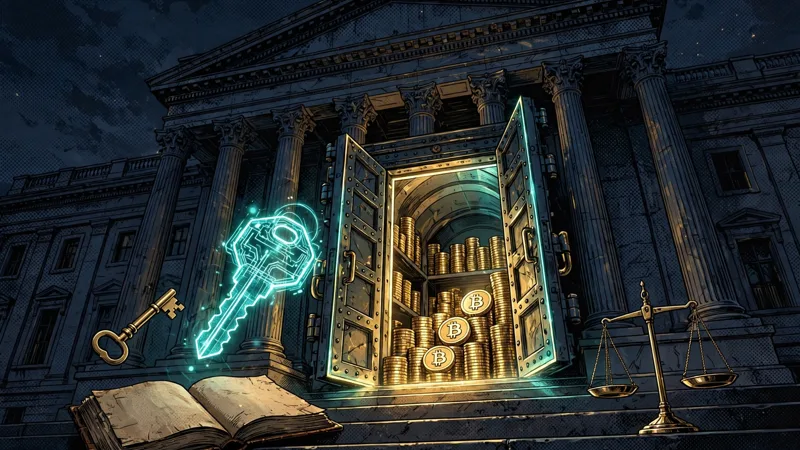
The US Treasury is building a custody framework for the Bitcoin ($BTC) the federal government holds, blending self-custody with third-party custodians rather than betting everything on one approach. The plan covers the coins in the Strategic Bitcoin Reserve, a stockpile built from law enforcement seizures that Washington has never fully counted in public.
The custody effort is tied to a broader push to make federal agencies' reporting on their Bitcoin ($BTC) holdings more accurate. Agencies are now running a second review of what they hold, after the first review ordered by the executive order that created the reserve. Until that review is finished, the size of the stash will stay uncertain, and so will the question of whether the public ever gets an exact number.
The custody framework
The framework is designed to support two models at once, Crypto Briefing reported on November 13. Self-custody means the government holds the private keys itself. Third-party custody means a specialized outside firm safeguards those keys on the government's behalf. No custodian has been named, and the Treasury has not published the framework itself, so the details of who holds which keys, and under what controls, are still to come.
The work is operational, not a response to an incident. Crypto Briefing reported that the Treasury's initiative is focused on custody plumbing and is not framed as a direct response to any outside breach.
198,000 to 328,000 Bitcoin, and why the count is fuzzy
Estimates of the federal government's Bitcoin ($BTC) holdings run from approximately 198,000 coins to more than 328,000 coins, according to Crypto Briefing. The gap largely comes down to whether coins tied up in pending litigation are counted.
Under the original executive order, agencies had 30 days to review and report what Bitcoin ($BTC) they controlled. The newer review is aimed at improving the accuracy of those figures, and it is the reason the custody framework is being built now: Washington wants to know exactly what it owns and exactly where it sits before it locks the custody arrangements in place.
The Strategic Bitcoin Reserve backdrop
All of this traces back to March 6, 2025. That day, an executive order, EO 14233, created the Strategic Bitcoin Reserve. The order allows the Treasury to manage forfeited Bitcoin ($BTC) and bars routine sales of those holdings, with sales permitted only in limited circumstances.
The reserve pulls together coins acquired mostly through civil and criminal asset forfeitures. These are assets the government picked up through law enforcement actions, not through purchases on the open market. That matters for the market, because the no-routine-sales provision means the government is holding rather than selling, so the coins are not a source of supply hitting exchanges. Historically, large government auctions of seized coins raised worries about supply hitting the market, and a reserve that holds rather than sells changes that calculus, though the limited exceptions in the order mean the door is not fully shut.
The acquisition routes on the table
Patrick Witt, a senior crypto policy adviser, said the Treasury has discussed several potential ways for the government to acquire more Bitcoin ($BTC), Longbridge and CoinLive reported on November 11, citing Odaily. The options include revaluing gold reserves, using the Exchange Stabilization Fund, converting other assets, and accepting Bitcoin ($BTC) for taxes and fees. Each option still requires further legal analysis before anything moves forward, and there is no consensus yet on how to approach them.
The reserve today is built from forfeitures. Any move to grow it through other means would need a legal foundation that, for now, is still being studied. Witt also said discussions are ongoing about whether to publicly disclose the government's specific holdings, and that decision has not been made.
No successor for the Crypto Council job
Witt also said no successor will be appointed to the White House executive director of the Crypto Council position, according to Longbridge and CoinLive. Its responsibilities will be distributed among departments including the White House Office of Legislative Affairs and the White House Counsel's Office. Witt himself left the council in October, and the White House Crypto Council is now left with no staff of its own.
The cold wallet backdrop
The custody push lands while the industry is paying closer attention to cold wallet security. A cold wallet stores private keys offline, typically on a dedicated hardware device, to keep them away from internet-based attacks. Recent high-profile firmware issues in hardware wallets have complicated that reputation and pushed custodial practices back into the spotlight.
On November 12, Trezor said it had confirmed spy implants in three Safe 5 hardware wallets sold through a Malaysian reseller, and cut its authorized reseller network by about 80 percent. The Treasury's framework is not presented as a response to that incident, but it arrives in a week when the security of the devices that hold crypto's keys is under fresh scrutiny.
The market context
The news landed on a weak week for crypto markets. Bitcoin ($BTC) traded near $71,000 in the early hours of November 13, down about 3.7 percent on the day after falling below $72,000 overnight, according to Finnhub data. US spot Bitcoin ($BTC) exchange-traded funds have now recorded five straight days of outflows, and the Crypto Fear and Greed Index stood at 28, in Fear territory, on November 12.
What to watch next
The next facts to watch are whether the Treasury publishes the custody framework or names the custodians who will hold the reserve's keys, whether officials decide to disclose the government's specific Bitcoin ($BTC) holdings and what number the second holdings review produces, whether the legal analysis on acquisition routes such as gold revaluation or the Exchange Stabilization Fund moves forward, whether the October producer price index, due November 13, moves the market before the Federal Reserve's December 9 decision, and whether Binance confirms the reopening of withdrawals for the six tokens still restricted after the hack.
Sources
- Crypto Briefing, US Treasury plans Bitcoin custody framework as cold wallet security draws scrutiny, November 13, 2026 (primary source: the US Treasury is building a custody framework for the Bitcoin the federal government holds, combining self-custody with third-party custodians; estimates of government holdings run from approximately 198,000 BTC to more than 328,000 BTC, with the gap largely down to coins tied up in pending litigation; EO 14233 created the Strategic Bitcoin Reserve on March 6, 2025 and bars routine sales; Patrick Witt said discussions are ongoing about whether to publicly disclose the government's specific holdings and no decision has been made; the initiative is focused on operational custody and is not framed as a direct response to any outside breach)
- Longbridge (CoinLive), U.S. Treasury Discussed Bitcoin Purchase Routes as Holdings Undergo Second Review, November 11, 2026 (secondary source, citing Odaily: Patrick Witt said the Treasury has discussed several potential ways for the government to acquire Bitcoin, including revaluing gold reserves, using the Exchange Stabilization Fund, converting other assets, and accepting Bitcoin for taxes and fees, each still requiring further legal analysis; US agencies' Bitcoin holdings are undergoing a second review; the Treasury is developing a custody framework that could combine self-custody with third-party custody; no successor will be appointed to the White House executive director of the Crypto Council position)
This article is news reporting and is not investment advice.
MABOnChain Daily Brief
The key crypto and markets stories in one short, plain-language email. Free. Unsubscribe any time.
Prefer chat? Join us on Telegram Watch on YouTube
Keep reading

US Seizes $1.2 Billion of Binance Hack Crypto and Takes Down North Korea's $400 Million FaceStealer Deepfake Scheme
The US Justice Department said on November 12, 2026 that it has obtained court authorization to seize or restrain more than $1.2 billion in cryptocurrency stolen from Binance in the October 29 hack, which the FBI blames on North Korean military hackers known as TraderTraitor. The department also seized cloud infrastructure used in the FaceStealer deepfake scheme, which has stolen more than $400 million in the last 18 months, and the FBI took back more than 900 webcam videos of victims. Collective US government and private sector efforts have frozen more than $2.7 billion of the more than $6 billion stolen from Binance, and the $1.2 billion under court orders is part of that freeze, not an additional recovery.
White House Sends Four SEC and CFTC Nominees to the Senate Ahead of a January Power Shift
The White House sent four bipartisan nominations for the Securities and Exchange Commission and the Commodity Futures Trading Commission to the Senate on November 12, 2026. The SEC picks are Democrat Kristin N. Johnson, a former CFTC commissioner, for a term expiring June 5, 2029, and Republican Steven Levine, a senior White House economic adviser, for a term expiring June 5, 2030. The CFTC picks are Republican Nathan Anonick for a term expiring June 19, 2031, and Democrat Matthew Rowland for the remainder of a term expiring April 13, 2028. The nominations arrive while Republicans still control the Senate, which they are set to lose in January after last week's midterm election losses.

Kalshi Ends Donald Trump Jr.'s Advisory Contract Over 1789 Capital's Polymarket Investment
Kalshi has ended its advisory contract with Donald Trump Jr. after his venture capital firm, 1789 Capital, increased its stake in rival prediction market Polymarket, Reuters reported on November 12, 2026. A Kalshi spokesperson confirmed the termination, called the decision mutual, and said talks to end the role began in August after 1789 Capital led Polymarket's most recent funding round. Trump Jr. joined Kalshi as a strategic adviser in January 2025 with an equity stake reported to be worth about $300,000, while 1789 Capital committed about $300 million to lead a $1 billion Polymarket funding round valuing the company at $21 billion, bringing its total Polymarket investment to roughly $500 million.
US Justice Department Backs Challenge to Illinois' 0.2% Crypto Tax as DeFi Giants Join the Fight
The US Justice Department filed a statement of interest on November 6, 2026 backing the legal challenge to Illinois' 0.2% Digital Asset Tax Act, the US Chamber of Commerce and SIFMA filed an amicus brief the same day, and a DeFi coalition led by the DeFi Education Fund, Andreessen Horowitz, Paradigm and Uniswap filed its own brief on November 11. The groups support the Blockchain Association and Crypto Council for Innovation lawsuit asking a Sangamon County court to strike down the tax, which levies 0.2% on the full value of digital assets exchanged, transferred or stored through a broker, even with no sale, gain or change of ownership. Illinois projected $60 million in fiscal 2027 revenue from the tax, which is already paused until July 1, 2027.