

Standard Chartered Pushes Back $2 Trillion Stablecoin Forecast to 2030 as Supply Stalls at $309 Billion

Published October 15, 2026, 11:40 UTC. Based on Standard Chartered's October 14, 2026 research note and reporting by The Block, CoinCentral, Altcoin Buzz, ForkLog and CoinTelegraph.
Standard Chartered has pushed back its forecast for the stablecoin market to reach $2 trillion by two years, from 2028 to 2030, citing a stall in supply growth that has kept the market near $309 billion for the past 12 months. Geoffrey Kendrick, the bank's global head of digital assets research, laid out the revised call in a research report published on October 14, 2026, which was cited by The Block. Kendrick kept the $2 trillion target itself unchanged, but said the flat supply this year forced the later timeline. He called the slowdown cyclical rather than structural, tying it to weak broader crypto market activity instead of any fundamental breakdown in demand.
Twelve months of flat supply
Kendrick first forecast a $2 trillion stablecoin market in April 2025. Since then, stablecoin supply has sat between $300 billion and $320 billion for a full year, and currently stands near $309 billion, according to the report. Getting from $309 billion to $2 trillion requires roughly 6.5 times growth, and the bank has now given that expansion two more years to arrive. Kendrick said previous periods of flat or falling supply were followed by renewed growth once crypto markets recovered, and that history is the case for keeping the $2 trillion number at all rather than cutting it.
The coins got busier while supply stood still
Supply measures one thing. Usage measures another, and usage is not flat. Monthly on-chain transfer value hit a record $19 trillion in May 2026, and this year's monthly average is just under $10 trillion, up from $4 trillion in 2025, according to Kendrick's figures. Stablecoin velocity, which measures how many times each dollar changes hands, has roughly doubled this year to about 30 times a month from 15 in 2025. The two biggest tokens behave very differently: USDC velocity rose to about 80 times a month from 45 in 2025, while USDT held steady near seven times, which fits how it is used, as dollar savings rather than spending money.
Four markets, different leaders
When the $2 trillion forecast was first made, stablecoin use was simpler and centered on savings in emerging markets. It has since split into four functions, according to the report. USDT dominates emerging-market savings. USDC leads developed-market payments, where stablecoins are replacing traditional finance operators. On crypto trading rails, USDC dominates the zero-yield segment, while Ethena's USDe is strong where users want yield. USDC also leads early transactions between AI agents, a segment Kendrick said is still small.
The challengers Standard Chartered is watching
Kendrick expects the sharpest competition to emerge in developed-market payments and transactions. He flagged potential challengers worth watching: Open USD (OUSD), built on the Global Dollar Network model aimed at trading venues, M^0, a stablecoin infrastructure provider built for longer-run growth, and A+, a planned network that would let banks issue a common stablecoin. Kendrick said the distribution of interest earned on stablecoin reserves, or yield capture, will likely decide which issuers and networks win market share as competition intensifies.
Regulation is the biggest risk
The main threat to the $2 trillion call is regulation, Kendrick said. The U.S. GENIUS Act takes effect in January 2027, and if other countries follow with similar rules, competition from bank-backed and multi-issuer stablecoins could increase. Meanwhile, proposed U.S. accounting changes could treat qualifying stablecoins as cash equivalents on corporate balance sheets, potentially encouraging broader use in business payments and settlement, according to CoinTelegraph's Crypto Today roundup. Kendrick also flagged yield capture and regulatory rules as the two forces that will shape how the sector develops.
This article is news reporting and is not investment advice.
Sources
- Standard Chartered research report by Geoffrey Kendrick, global head of digital assets research, published October 14, 2026, primary source for the 2030 forecast revision, the $309 billion supply figure, velocity and transfer-value data, the four market segments and the challenger list, cited by The Block
- The Block, October 14, 2026, original reporting on Kendrick's Wednesday report, including the $300 to $320 billion supply range and the cyclical-rather-than-structural framing
- CoinTelegraph Crypto Today, October 15, 2026, secondary coverage of the forecast revision, the $19 trillion May transfer record and the proposed accounting changes
- CoinCentral, October 15, 2026, secondary summary: $2 trillion by 2030, USDC velocity at about 80 times, USDT near seven times, and regulation as the main risk
- Altcoin Buzz, October 15, 2026, secondary summary: the April 2025 origin of the forecast, the 6.5x growth arithmetic and Circle's Q1 to Q2 2026 USDC circulation figures
- ForkLog, October 15, 2026, secondary summary of the forecast delay via The Block, including the OUSD, M^0 and A+ challenger list
MABOnChain Daily Brief
The key crypto and markets stories in one short, plain-language email. Free. Unsubscribe any time.
Prefer chat? Join us on Telegram Watch on YouTube
Keep reading

Crypto Hacks Hit $1.18 Billion in Q3 2026, Worst Quarter Since Early 2025, Hacken Reports
Security firm Hacken said on October 15, 2026 that crypto hacks stole $1.18 billion across 107 incidents in the third quarter of 2026, the worst quarter since Q1 2025. About 77%, roughly $906 million, traced to compromised suppliers and developer tools, disclosed but undeployed fixes, or infrastructure outside the scope of security audits.

ASIC Opens Consultation on Capital, Custody and Trading Rules for Crypto Platforms, Targets April 2027 Rollout
Australia's financial watchdog ASIC opened a public consultation on October 15, 2026 on proposed capital, custody and trading standards for crypto platforms and digital asset custodians. Industry feedback is due November 27, final guidance is expected in March 2027, and the new licensing framework takes effect April 8, 2027.
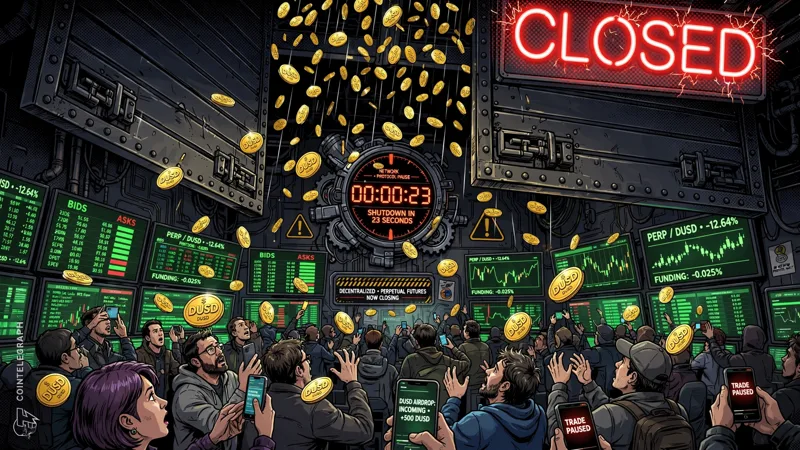
StandX Shuts Down Perpetuals Exchange, Cancels Token Launch, and Airdrops DUSD to 237,000 Users
Decentralized perpetual futures exchange StandX said on October 15, 2026 it will wind down its trading and stablecoin operations, cancel its planned native token launch, and distribute a one-time DUSD stablecoin airdrop to its community of more than 237,000 users, following a strategic review of the business. Perpetual contracts go reduce-only on October 20, and DUSD redemption and withdrawals end January 31, 2027.