

MSCI Finalizes 'Non-Operating Company' Rules, Strategy Faces Index Exit as MSTR Drops 9.6%

Published October 19, 2026, 2:10 AM PKT. Based on MSCI's October 15, 2026 announcement (primary source), Decrypt's October 15, 2026 report on the finalized rules (secondary source), FXStreet's October 16, 2026 coverage of the adoption (secondary source), and MABOnChain's October 10 and October 14, 2026 reporting on the original proposal (secondary source). This is a follow-up to the earlier story.
The decision that hung over Strategy for two months is now final. MSCI announced on October 15, 2026 that it has adopted rules making "non-operating companies" ineligible for its Global Investable Market Indexes, the GIMI family of benchmarks that sit behind ETFs and institutional mandates around the world. The methodology takes effect at the close of November 30, 2026, as part of MSCI's November index review, and the index provider will publish the final list of companies facing removal on November 11. MABOnChain first reported the proposal in August and Strategy executive chairman Michael Saylor's "discriminatory" response earlier this month; this follow-up covers the final rule and the market's verdict.
The two screens MSCI will run on every constituent
Under the finalized methodology, MSCI first applies a core screen measuring how much of a company's assets serve real operations. Firms whose operating assets fall below 50% of their total move to a second, exclusion screen built on five financial ratios covering operating assets, core business costs, cash generated by the business, fair-value swings of non-operating holdings, and dependence on outside funding. A company that fails four or more of the five tests becomes ineligible for the indexes. The rules implement MSCI's August proposal with minor modifications, after a consultation that ran from August 3.
November 11 list, November 30 guillotine
To limit index churn, MSCI built in buffers. Existing index constituents are removed only if they fail the ineligibility screen in each of their two most recent annual filing periods, while prospective additions are blocked if they fail in either of the last two periods. The final list of affected companies comes on November 11, 2026, and the changes take effect after the close of trading on November 30. The decision also scraps the interim measures MSCI imposed on October 10, 2025, which had frozen share counts, float adjustments, and additions for companies whose digital assets made up 50% or more of total assets; that temporary regime lapses at the November review and every affected firm is now assessed under the new rules.
MSTR's $5.6 billion Friday
The market did not wait for the removal list. Strategy (MSTR) closed at $136.83 on October 16, down 9.56% in a single session, erasing about $5.6 billion of market value on roughly 31.8 million shares traded, about 1.44 times normal volume, according to market data cited by analysts. JPMorgan analysts had previously estimated that removing Strategy from MSCI indexes could trigger roughly $2.8 billion in forced selling by index-tracking funds, though that figure was calculated against MSCI's earlier digital-asset proposal rather than the adopted rules. MSCI-tracking funds hold about 3.1% of Strategy's shares, worth roughly $1.63 billion at the October 16 close. Saylor's firm holds 717,722 Bitcoin acquired at a total cost of $54.56 billion, after adding 592 BTC for about $40 million, a balance sheet dominated by a single asset in exactly the way the new screens target.
The watchlist: Metaplanet, Upexi, SharpLink and more
Strategy is not the only company in MSCI's sights. MSCI had previously named Strategy (MSTR), Japan's Metaplanet and Upexi among the companies that would be deleted under the methodology, while SharpLink (SBET), Ton Strategy Company (TONX), Solana Company (HSDT) and DeFi Development Corp (DFDV) were put on a watchlist for potential removal. A confirmed removal would channel mechanical selling through index-tracking products. Conner Brown, executive director of the Bitcoin Policy Institute, warned in September that exclusion "removes a company from the default portfolios of tens of millions of people who never chose to remove it," a consequence the November 11 list will now make concrete.
This article is news reporting and is not investment advice.
Sources
- MSCI announcement, October 15, 2026, primary source: adopted the "non-operating companies" methodology for the MSCI Global Investable Market Indexes, implementing the August proposal with minor modifications after consultation; core screen on operating assets below 50% of total, then five-ratio exclusion test with four failures marking ineligibility; existing constituents removed only if they fail in each of two most recent annual filing periods; final affected list published November 11, 2026; changes effective at the close of November 30, 2026; interim measures from October 10, 2025 for firms with digital assets at or above 50% of total assets lapse at the November review
- Decrypt, October 15, 2026, secondary source: targets bitcoin treasury firms whose balance sheets are dominated by a single asset, including Strategy and Metaplanet; Saylor called the rule "discriminatory"; MSCI previously flagged Strategy for deletion in its own simulation; interim 2025 reprieve for companies with 50%+ digital-asset holdings now scrapped
- FXStreet, October 16, 2026, secondary source: MSCI said it will adopt the methodology proposed in August; Strategy, Metaplanet and Upexi face removal; SharpLink (SBET), Ton Strategy Company (TONX), Solana Company (HSDT) and DeFi Development Corp (DFDV) on a watchlist; removal would force index-tracking funds to sell; Conner Brown quote on default portfolios; JPMorgan's earlier $2.8 billion forced-selling estimate was based on the earlier proposal
- WealthEngine/CoinOTAG, October 16-17, 2026, secondary source: MSTR closed at $136.83 on October 16, down 9.56%, erasing about $5.6 billion of market value; MSCI-tracking funds hold 3.1% of Strategy's shares, about $1.63 billion at that close; volume about 1.44 times normal
- MABOnChain, October 10 and October 14, 2026, secondary source: original reporting on MSCI's proposal and Saylor's response
MABOnChain Daily Brief
The key crypto and markets stories in one short, plain-language email. Free. Unsubscribe any time.
Prefer chat? Join us on Telegram Watch on YouTube
Keep reading

Cysic Attacker Sold 7.2M Minted Tokens and Bridged $727,000 to Ethereum Before the Blacklist
On-chain records reviewed by The Block show the attacker who exploited Cysic's cross-chain bridge on October 17 sold 7.2 million of the 10 million fraudulently minted CYS tokens in 26 transfers within 28 minutes, then bridged the proceeds off BNB Chain and received 306.6 ETH, worth about $727,000, on Ethereum before Cysic blacklisted the recipient address. The remaining 2.8 million CYS was frozen by the blacklist, and the bridge stays closed until a security review ends.

Trump Waives Russia Tariffs as October 18 Deadline Arrives, Rubio Announces 60-Day Review
President Donald Trump signed an October 16 executive order waiving sanctions and tariffs under the Graham Act days before they were due to take effect, and Secretary of State Marco Rubio said Saturday the president will take up to 60 days to weigh the economic impact. Bitcoin held near $81,600 on Sunday, about 35% below its record, as traders turned to the Federal Reserve's October 28 meeting.

Qubic Loses $1.3M as 1,404 Wallets Drained in Seed-Randomness Attack, Network Halted
Qubic halted its network at tick 85,371,949 on October 18, 2026, after an attacker drained 1,404 wallets of 2.94 trillion QU worth about $1.3 million between October 17 and 18. The project says the theft exploited insufficient randomness in wallet seeds generated on older Apple devices and browsers, not the Qubic protocol itself. About 87.1% of the stolen tokens remain immobilized on the paused network, while MEXC froze the 12.9% that reached the exchange.

Gitcoin (GTC) Jumps 13% to $0.25 as Upbit Listing and Techne Rebrand Momentum Holds
Gitcoin's GTC token climbed about 13% on October 18, 2026, leading Binance's top-volume gainers as momentum from Upbit's October 12 Korean won listing and the protocol's Techne rebrand held into a second week. GTC traded near $0.25 late Sunday after touching an intraday high near $0.29, with roughly $124 million in 24-hour turnover across exchanges, according to market data.

Thai Police Arrest Chinese Suspect in Bangkok Over Alleged $75M Laundering Network
Thai immigration police detained 37-year-old Chinese national Wu Chaoshuai at a luxury housing estate in Bangkok's Saphan Sung district on October 16, 2026. Chinese authorities had issued a warrant for him over an alleged transnational crime network that moved more than 500 million yuan through crypto and foreign-currency exchanges across more than 133 accounts. His Thai visa expired more than three years ago; Thailand plans to deport him to China after immigration proceedings.

Cysic Halts Cross-Chain Bridge After Attacker Mints 10 Million CYS on BNB Chain
Cysic suspended its cross-chain bridge after an attacker exploited a processing flaw to mint 10 million CYS on BNB Smart Chain on October 17, 2026. Preliminary findings point to unauthorized access to a database supporting the bridge; the recipient address was blacklisted about 76 minutes later with roughly 2.8 million CYS frozen in it. Cysic says no user wallets were touched and the mainnet was unaffected, and that the mint size alone does not establish the dollar loss, which is still under review.

Vitalik Buterin Builds 'Paranoid Mode' AI Agent Setup Using Tor, Cover Traffic and zkAPI
Ethereum co-founder Vitalik Buterin unveiled an experimental 'paranoid mode' for his pi AI agent harness that routes every conversation through a separate Tor circuit, masks requests with random cover traffic, pays for model access through the Ethereum-based zkAPI payment system, and rewrites every prompt locally before it reaches the provider. He says the setup is getting usable but still slow, and warns that Tor is a poor fit against a provider colluding with the network guard, calling instead for a specialized mixnet.

Bitget Names Russia, Belarus and Kazakhstan as Prohibited Jurisdictions, Bans 20 Sanctioned Platforms
Bitget's English Terms of Use, updated October 16, 2026, list Russia, Belarus and Kazakhstan among its prohibited jurisdictions, three days after the exchange said it would discontinue services for selected users in a one-off exercise. Separately, the exchange's Greater China arm said it will terminate accounts that transact with 20 sanctioned platforms, including BitPapa and NoOnecrypto, with a permanent no-re-registration rule for violators.
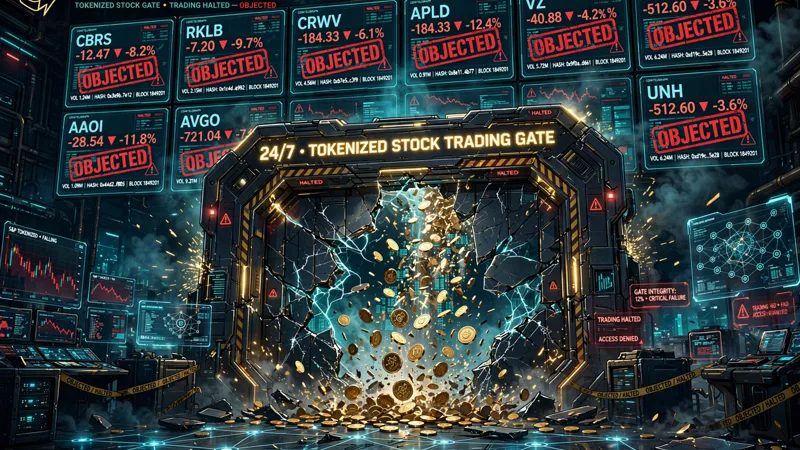
Nine Companies, Including Broadcom and Verizon, Formally Object to OKXICE Tokenized Share Trading
Nine U.S.-listed companies, including Broadcom, Verizon, CoreWeave and UnitedHealth, filed formal issuer objections in an October 15, 2026 OKXICE notice, using the SEC's issuer-objection mechanism to keep their shares off the 24/7 tokenized stock venue. Eight of the nine were among the 63 tickers OKXICE named on October 4; the venture says it still plans to launch with dozens of stocks including Nvidia and Apple.

EU and 8 Nations Sign Warsaw Protocol to Seize Criminal Crypto Across Borders
The European Union and eight countries signed the Additional Protocol to the Council of Europe's Warsaw Convention in Strasbourg on October 14, 2026, writing crypto-assets explicitly into the international framework for seizing criminal proceeds. The protocol lets authorities confiscate virtual assets urgently without prior notice, gives financial intelligence units power to suspend suspect crypto transactions, requires Asset Recovery and Asset Management Offices in signatory states, and needs five ratifications to enter into force.