

SWI Raises €800 Million to Turn FTX-Backed Bitcoin Miner Genesis Digital Into AI Data Centers
Published October 13, 2026, 03:15 PKT. Based on SWI Group's October 12, 2026 announcement as reported by Blockhead and Unlock Blockchain, Wall Street Journal reporting on the company, and Bloomberg Law and The Crypto Times on the FTX Recovery Trust's dismissed lawsuit.
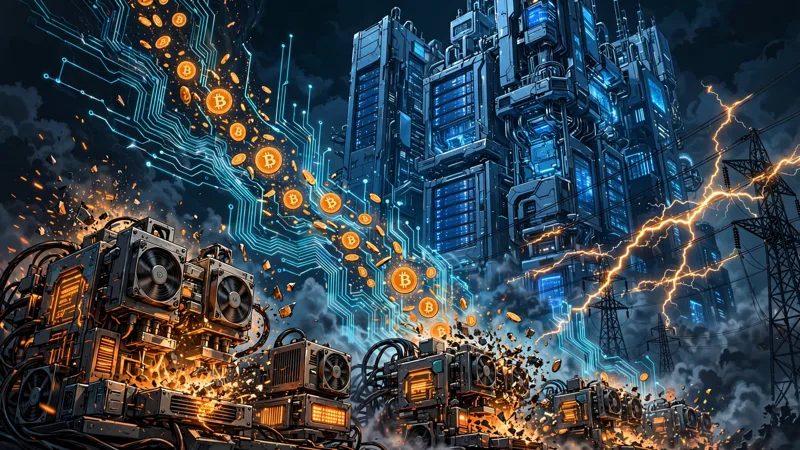
SWI Group has raised €800 million (about $900 million) to expand its data center and artificial intelligence compute business, betting that the fleet of Bitcoin mining sites it acquired from Genesis Digital Assets is worth more selling computing power to hyperscalers than mining coins. The capital increase, announced on October 12 and issued to unnamed institutional investors, values SWI at €6.1 billion and takes the equity the company has raised since March 2026 past €1 billion.
The €800 million capital increase
The Euronext Amsterdam-listed group, which trades under the ticker SWICH and is incorporated in Singapore, said the shares were issued to institutional investors without naming them, according to Blockhead's October 12 report. The proceeds will go into power infrastructure, compute deployments and the group's development pipeline in Europe and the United States.
The raise is the largest leg of a rapid funding run. SWI had already completed a €260 million private placement in March with its founder and the Aliya Fund, The Crypto Times reported, and an earlier statement from the company said its equity raised since March had crossed €1 billion even before Monday's announcement. Chief executive Max-Hervé George, the group's founder, had a market capitalization of roughly $6 billion for the company as of October 9, according to the Wall Street Journal.
1.3 gigawatts across 15 sites
The headline asset in the deal is not servers but power. Genesis Digital holds more than 1.3 gigawatts of energized and approved grid connections across 15 facilities, mostly in Texas with smaller sites in North Carolina, South Carolina and Sweden, Unlock Blockchain reported. Folded into SWI's existing European platform AiOnX, the acquisition lifts the group's total capacity to about 3.6 gigawatts.
George told the Wall Street Journal that the intended customers are hyperscale cloud providers such as Amazon Web Services and Google Cloud, and that he has "zero interest" in bitcoin mining. SWI is selling Genesis Digital's last three small mining sites in Kazakhstan, he said, and plans to rename the company SWI Digital to serve as its U.S. digital infrastructure platform, according to The Crypto Times.
From Bitcoin rigs to AI workloads
Conversion is not a simple swap. Mining rigs tolerate interrupted power and rough conditions far better than AI clusters, which demand robust cooling, networking and uptime guarantees, CryptoBriefing noted. The 1.3-gigawatt figure is a measure of grid potential, not finished AI capacity, and the buildings will need heavy redevelopment before they can host hyperscale workloads.
Alameda's $1.15 billion and the dismissed lawsuit
Genesis Digital carries one of the more awkward histories in crypto mining. Sam Bankman-Fried's Alameda Research put about $1.15 billion into the company between August 2021 and April 2022, taking roughly a 20% stake when the miner was valued near $5.5 billion, according to KuCoin News. The Wall Street Journal described the investment as "one of Bankman-Fried's most reckless investments" and called its Kazakh assets "virtually worthless."
After FTX collapsed in November 2022, the FTX Recovery Trust sued Genesis Digital, four related U.S. entities and the company's co-founders Rashit Makhat and Marco Krohn in the U.S. Bankruptcy Court for the District of Delaware on September 23, 2025, filing the case as adversary proceeding No. 25-52358, Bloomberg Law reported. The trust alleged that Alameda had bought several tranches of shares at heavily inflated prices with commingled and misappropriated funds, and sought to claw back about $1.15 billion. Genesis Digital moved to dismiss the case in January 2026, arguing that as a Cypriot company headquartered in Dubai it should not have to defend the claims in a U.S. court, The Crypto Times reported.
The trust then dropped the case. A two-page dismissal notice filed on June 15 ended all claims with prejudice, meaning they cannot be refiled, and was submitted under a procedural rule that lets a plaintiff end a case without a court order, so no judge had to approve it, The Crypto Times reported. Neither the trust nor SWI has disclosed what, if anything, the FTX estate received in return. George told the Journal that all legal disputes involving FTX and other shareholders have been settled.
The timing is notable: SWI closed its initial $500 million purchase of about 38.3% of Genesis Digital's shares, including roughly 77.2% of the $1.124 billion liquidation preference on its preferred stock, on June 15, the same day the suit was dismissed, according to Blockhead. SWI later moved to majority ownership, completing control of more than 70% in August through share purchases and restructuring, KuCoin News reported.
The miner's story is another data point in the FTX estate's long recovery effort. Bankman-Fried is serving a 25-year prison sentence for fraud and conspiracy, while his $500 million 2021 bet on the AI company Anthropic gave FTX a 7.8% stake that the estate sold for $1.3 billion in 2024, CryptoCompass reported. The Genesis Digital sites, which sat in a legal freeze through the bankruptcy process, are now being marketed as the power backbone of an AI data center empire.
This article is news reporting and is not investment advice.
Sources
- SWI Group's October 12, 2026 capital increase announcement, primary source for the €800 million raise, the €6.1 billion valuation and the planned use of proceeds, as reported by Blockhead
- Unlock Blockchain's October 12, 2026 report, primary source for the 1.3-gigawatt figure, the 15-facility footprint and the 3.6-gigawatt group total
- The Wall Street Journal, primary source for Max-Hervé George's remarks on hyperscaler customers, his "zero interest" in bitcoin mining and the resolution of legal disputes, as quoted in coverage
- Bloomberg Law's June 2026 report, primary source for the lawsuit dismissal (FTX Recovery Trust v. Genesis Digital Assets Ltd., Bankr. D. Del., No. 25-52358)
- The Crypto Times' October 12, 2026 report, secondary source for the March €260 million placement, the €1 billion equity total, the two-page dismissal notice and the undisclosed consideration
- KuCoin News' October 12, 2026 report, secondary source for Alameda's $1.15 billion investment, the 20% stake, the $5.5 billion valuation and SWI's move to majority ownership
- CryptoBriefing's October 12, 2026 report, secondary source for the conversion risks of mining sites to AI data centers
MABOnChain Daily Brief
The key crypto and markets stories in one short, plain-language email. Free. Unsubscribe any time.
Prefer chat? Join us on Telegram
Keep reading
OKX's Star Xu Clashes With Binance's CZ and Yi He Over October 10 Crash and $800M Compensation
OKX founder Star Xu clashed publicly with Binance co-founders Changpeng Zhao and Yi He on October 12, 2026 over how Binance responded to the October 10, 2025 crash. Xu challenged CZ's claim that Binance had voluntarily spent roughly $800 million compensating users, objected to the word voluntary, and asked who the crypto industry's Yue Buqun was.

KuCoin Lists Incentiv's CENT as World Premiere, Triple-Exchange Debut Goes Live October 12
KuCoin announced on October 11, 2026 that Incentiv's native CENT token would join its spot platform under the exchange's World Premiere label, with CENT/USDT trading opening at 9:00 UTC on October 12 after a one-hour call auction. CENT also began trading on Gate and MEXC the same morning, giving the new EVM-compatible proof-of-work Layer 1 a triple-exchange debut.

ASIC Proposes Leverage Caps for Crypto-Settled Derivatives, Extends CFD Rules to 2037
The Australian Securities and Investments Commission proposed on October 12, 2026 to extend its retail leverage caps, margin close-out rules and negative balance protections to derivatives settled by transferring digital assets. The proposal would also renew the product intervention order for 10 more years, to 2037, subject to ministerial approval.