

South Korea Unveils Digital Asset Bill With Bank-Led Won Stablecoins and a 20% Exchange Ownership Cap
Published November 24, 2026, 2:45 PM PKT. Based on the Financial Services Commission announcement at its Virtual Asset Committee meeting on November 24, 2026 (primary source), with corroboration from BloomingBit, Seoul Economic Daily and MoneyToday, all published November 24, 2026.
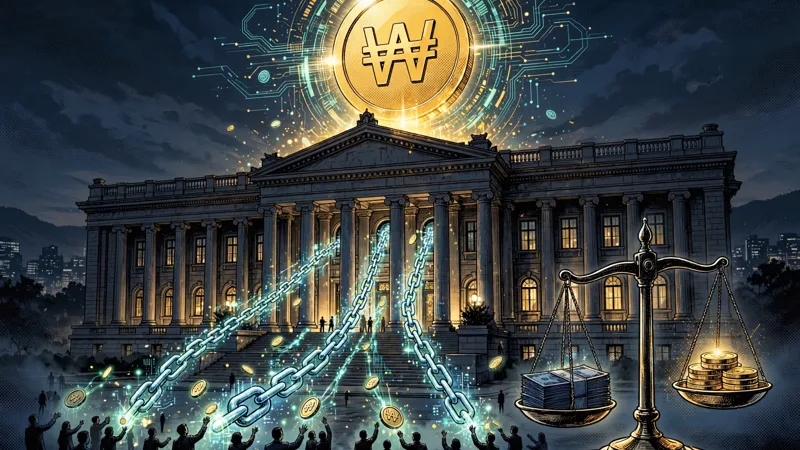
South Korea has taken the biggest step yet toward a legal won-denominated stablecoin. The Financial Services Commission unveiled its government bill for the Digital Asset Industry Act on November 24, at a meeting of its Virtual Asset Committee chaired by FSC Chairman Lee Eog-weon, setting out the second phase of the country's crypto framework after more than a year of review.
The bill does three things at once. It creates a legal path for won stablecoins, issued first by consortia in which banks hold a majority stake. It caps how much of a crypto exchange any major shareholder can own, at 20 percent in principle and up to 34 percent with regulator approval. And it reopens domestic token sales, known as ICOs, for the first time since South Korea banned them outright in 2017.
The framework is built on three pillars, according to BloomingBit: fostering innovation in the digital asset industry, creating a fair and efficient market, and building a safe and reliable trading environment. The bill would also replace the legal term "virtual asset" with "digital asset" and split the sector into five business categories, trading, brokerage, custody, platform operation and operation, with licensing, registration or designation plus conduct rules comparable to those applied to financial companies.
Won stablecoins go to bank-led consortia first
The stablecoin rules are the centerpiece, and banks go first. Issuance would be permitted starting from consortia in which banks hold a majority stake and which hold own capital of at least 5 billion won, about $3.6 million, according to MoneyToday. Issuers would need authorization from the FSC, hold reserve assets equal to at least 100 percent of the stablecoins outstanding, and guarantee holders the right to redeem at face value, according to BloomingBit.
Stablecoins with issuance of 1 trillion won, about $680 million, or more would be designated significant digital payment tokens and face extra rules, including additional capital buffers and tighter liquidity management, according to Seoul Economic Daily. Fintech and technology companies would still be allowed to participate as the largest individual shareholder and lead a consortium's operations, and the FSC said non-bank consortia could be allowed to issue once the system is established, with the details left to an enforcement decree.
Foreign issuers are in the picture too. Overseas operators such as Tether ($USDT) and Circle, the issuer of USD Coin ($USDC), would be able to issue and redeem tokens in South Korea if they establish a domestic branch and register with the FSC, according to Seoul Economic Daily.
Exchanges face a 20 percent ownership cap, with 34 percent possible
The ownership cap is the provision that has caught the industry off guard. The bill sets a general cap of 20 percent on major shareholders of crypto exchanges, in line with the rules for alternative trading systems in South Korea's capital markets, according to BloomingBit. An exception in the enforcement decree would allow holdings of as much as 34 percent with FSC approval, including in cases involving financial companies, and voting rights on shares held above the cap would be restricted.
Existing exchanges would get a three-year grace period after designation, and smaller operators could receive an additional three years to attract investment, according to BloomingBit and Seoul Economic Daily. The bill would also impose governance rules similar to those for financial companies, including a requirement that outside directors make up a majority of the board and that an audit committee be installed.
That matters most for the biggest venues. Exchanges such as Upbit and Bithumb would be subject to the cap as digital asset platform operators, according to MoneyToday, and the cap had been repeatedly reported as a possibility since late last year before the government formally confirmed it. MoneyToday reported that the industry is struggling to hide its dismay, and that the ownership cap, the bank-first stablecoin rules and the high barriers for token sales are the provisions that surprised it most.
ICOs return after a nine-year ban
The bill would allow domestic issuance and sale of digital assets, known as initial coin offerings, provided sufficient disclosures are made. Issuers would have to file a white paper with the FSC covering the intended use of funds, issuance volume, project information and investment risks, according to BloomingBit, and exchanges would have to provide information on listed assets and immediately disclose anything with a material effect on prices, such as changes in issuance or circulating supply.
The opening is real but narrow. The complete ICO ban has stood since 2017, and the new route comes with white paper filing, acceptance conditions and ongoing disclosure duties, which MoneyToday said the industry sees as high barriers. The FSC left key questions, including whether the ownership restrictions should also apply to parent companies, to parliamentary discussions and enforcement decrees.
Strict liability for hacks, and a bill that is not yet law
User protection is the sharpest part of the bill. Operators would in principle bear strict liability for damages from hacking or system failures, meaning users would not have to prove fault, according to Seoul Economic Daily. If an incident occurs because a firm violated its duty to ensure IT safety, authorities could impose punitive surcharges of as much as 10 percent of revenue. Firms would also have to meet internal control standards and IT safety measures at a level comparable to financial companies, and maintain a standing inspection system for user assets, according to BloomingBit.
None of it is law yet. Although the government bill has been released, National Assembly passage and the enactment of subordinate regulations remain before the framework takes effect, according to MoneyToday. FSC officials said stablecoin issuance would come about one year after the law is promulgated, and since it must then go through issuer licensing and issuance approval, they said it is difficult to state a firm date.
FSC Chairman Lee Eog-weon said the proposal "will also contribute to innovation across the financial industry by fostering new industries through fresh capital inflows and creating jobs," according to Seoul Economic Daily. The industry response was cooler. Hwang Seok-jin, a professor at Dongguk University's Graduate School of Information Security, said the plan "is significant in bringing the digital asset industry into the regulated sphere, through steps such as institutionalizing won-denominated stablecoins and allowing domestic ICOs," but added that "the ownership limits on exchange shareholders, the bank-centered stablecoin issuance and entry rules on par with those for financial companies could stand in the way of innovation."
This article is news reporting and is not investment advice.
Sources
- Financial Services Commission, government bill on the Digital Asset Industry Act unveiled at the Virtual Asset Committee meeting, November 24, 2026 (primary source: the FSC unveiled the government bill on the Digital Asset Industry Act at a meeting of the Virtual Asset Committee chaired by FSC Chairman Lee Eog-weon; the bill would initially allow won-denominated stablecoins to be issued by bank-led consortia and cap major shareholders' stakes in cryptocurrency exchanges at 20 percent in principle, with an upper limit of 34 percent; it would also allow domestic digital asset issuance and sales through initial coin offerings, provided sufficient information is disclosed; the legislation is the second phase of the country's virtual asset regulatory framework, covering the definition of digital assets, stablecoin issuance requirements, ownership dispersion rules for exchanges, and user protection and business conduct regulations; stablecoin issuance will be permitted starting from consortiums in which banks hold a majority stake and possess own capital of 5 billion won or more; the bill divides digital asset businesses into five categories by function, trading, brokerage, custody, platform operator and operation; National Assembly passage and the enactment of subordinate regulations remain before institutionalization)
- BloomingBit, South Korea Unveils Digital Asset Bill With 20% Exchange Ownership Cap, Bank-Led Stablecoins, published November 24, 2026 (secondary source: the proposed Act on the Innovation of the Digital Asset Industry and User Protection was disclosed on November 24 and is built around three pillars, fostering innovation, creating a fair and efficient market, and a safe and reliable trading environment; the government would replace the legal term "virtual asset" with "digital asset" and split the sector into four business categories plus platform operators, subject to licensing, registration or designation and conduct rules comparable to financial companies; won stablecoin issuance would first be allowed for consortiums in which banks hold a majority stake, with a minimum capital requirement of 5 billion won, about $3.6 million, reserve assets of at least 100 percent of outstanding issuance and a guaranteed right to redeem at face value; the government would designate and manage important stablecoins based on issuance size and user numbers; the general exchange ownership cap is 20 percent, with an exception allowing as much as 34 percent if approved by the FSC, and voting rights on shares above the cap would be restricted; existing and new exchanges would get a three-year suspension of the ownership-dispersion rules, with smaller exchanges eligible for an additional three years; outside directors would have to make up a majority of the board and an audit committee would be required; ICOs would be allowed with a white paper filed with the FSC covering use of funds, issuance volume, project information and investment risks; exchanges would have to disclose material price information such as changes in issuance or circulating supply; operators would bear strict liability for hacking or system failures in principle, with punitive surcharges of as much as 10 percent of revenue where IT safety duties were violated)
- Seoul Economic Daily, Korea to Cap Crypto Exchange Ownership Stakes at 34%, published November 24, 2026 (secondary source: the government will cap the stake a major shareholder can hold in a cryptocurrency exchange at 34 percent, with a 20 percent limit on par with alternative trading systems and up to 34 percent with separate approval for financial companies and similar entities; existing exchanges receive a three-year grace period and small and mid-sized operators an additional three years; won stablecoin issuance will be permitted first to consortiums in which banks hold more than half the equity, while fintech or technology companies may participate as the largest shareholder; stablecoins with issuance of 1 trillion won, about $680 million, or more will be designated significant digital payment tokens and subject to extra capital buffers and tighter liquidity management; overseas operators such as Tether (USDT) and Circle (USDC) will be able to issue and redeem tokens in South Korea if they file with the FSC; domestic ICOs will be permitted; liability for damages from hacking or computer system failures will be recognized without proof of fault, with punitive fines of up to 10 percent of revenue where clear negligence is found; FSC Chairman Lee Eok-won said the proposal will contribute to innovation across the financial industry by fostering new industries through fresh capital inflows and creating jobs; Hwang Seok-jin, a professor at Dongguk University's Graduate School of Information Security, said the plan is significant in bringing the digital asset industry into the regulated sphere but that the ownership limits, bank-centered stablecoin issuance and financial-company-level entry rules could stand in the way of innovation)
- MoneyToday, FSC says constitutional concerns addressed, pushes ahead with exchange ownership cap, published November 24, 2026 (secondary source: the FSC said the timing for stablecoin issuance is one year after the promulgation of the law, and since it must go through issuer licensing and issuance approval thereafter, it is difficult to state definitively; the FSC will delegate specific shareholder composition requirements to an enforcement decree so that non-bank consortiums can also issue stablecoins once the system is established; foreign issuers under the supervision of their home country's regulatory authority can also issue and redeem stablecoins domestically after establishing a domestic branch and registering with the FSC)
MABOnChain Daily Brief
The key crypto and markets stories in one short, plain-language email. Free. Unsubscribe any time.
Prefer chat? Join us on Telegram Watch on YouTube
Keep reading
EU Proposes 22nd Russia Sanctions Package Targeting Crypto Platforms and 60 Banks
The European Commission has presented its 22nd package of sanctions against Russia, proposing a transaction ban on about 60 Russian banks, their removal from the SWIFT messaging system, and a crackdown on crypto and payment networks that help Russia evade sanctions, including in third countries. The package, presented by Commission President Ursula von der Leyen on November 23, is backed by the Crypto Sanctions Task Force launched earlier in November, and it needs unanimous approval from all 27 member states before it becomes law.

ECB to Accept Tokenized Securities From DLT Pilot Platforms as Eurosystem Collateral From June 2027
The European Central Bank's Governing Council has approved accepting marketable assets issued on distributed ledger platforms licensed under the EU DLT Pilot Regime as eligible collateral for Eurosystem credit operations, with the change taking effect in June 2027. Eligible securities must meet all standard collateral criteria and reach the Eurosystem through a central securities depository that settles on TARGET2-Securities, and the decision covers tokenized securities, not Bitcoin or stablecoins. It is the second expansion of the Eurosystem's collateral framework for DLT-based assets in under a year.
Coinbase Wins Dismissal of TerraUSD Class Action as Judge Rules Its Disclosures Were Enough
A federal judge in California has dismissed Larry Pearl's class action against Coinbase over TerraUSD purchases made shortly before the token collapsed in May 2022, ruling that Coinbase's website had already disclosed that the stablecoin was not backed by U.S. dollars in a bank account and that minting it required burning its sister token LUNA. Judge Maxine M. Chesney also rejected the claim that TerraUSD was an unregistered security, finding Pearl failed to plead a common enterprise or an expectation of profit under the Howey test. The dismissal, without leave to amend, ends the case at the district court level.
Kalshi Pauses Utah Operations for 177,000 Users as New York Judge Lets It Keep Trading
Kalshi has paused operations in Utah, cutting off more than 177,000 users from placing new event contracts, after a federal judge let the state enforce its gambling laws and an appeals court refused to block enforcement. The same day, a New York judge declined the state attorney general's request for a temporary restraining order, so Kalshi keeps trading in New York while the Commodity Futures Trading Commission's bid to stop Utah's enforcement waits for a ruling.