

DOJ's Joint Disruption Week: 28 Arrests and 3.7 Million Fake Accounts Removed in West Africa Scam Crackdown
Published October 14, 2026, 08:45 UTC. Based on the U.S. Department of Justice announcement of October 13, 2026, with reporting from Cryptopolitan, CoinTurk, Nation Press and TradersUnion.
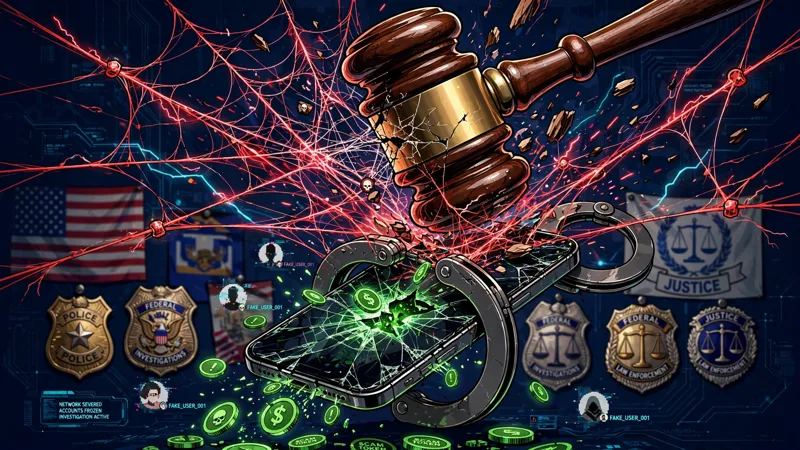
The U.S. Justice Department announced on October 13 that a first-of-its-kind international operation called Joint Disruption Week targeted scam networks operating out of West Africa, producing 28 arrests in Ghana and Nigeria, the removal of more than 3.7 million accounts, pages and groups across tech platforms, and the identification of over $11 million in cryptocurrency that could potentially be frozen, the department said.
The first coordinated strike on West Africa's scam networks
The operation, which ran from October 6, was the first ever coordinated international action against scam networks based in West Africa, according to the Justice Department. It was hosted at the U.K. National Crime Agency headquarters in London and brought together investigators from the United States, the United Kingdom, India, Canada, Australia, Nigeria and Ghana, alongside private companies, according to the department and multiple reports. The targets included crypto investment fraud known as pig butchering, law-enforcement impersonation scams, digital arrest extortion, fake job offers, romance scams and fraudulent recovery services, with victims concentrated in the United States and Britain.
28 arrests, 303 devices, and 117 trafficking victims in Accra
In Ghana, police arrested 19 people in the Accra suburb of Sasaabi and seized 303 electronic devices, according to the Justice Department. Nigerian officers arrested nine people and seized 53 devices. Officers in Ghana also found 117 human trafficking victims who had been forced to run scams, and those victims are now awaiting repatriation to Nigeria, the department said. Investigators identified 89 scam victims in Ghana with combined losses of approximately $8.3 million, according to TradersUnion.
3.7 million accounts erased across tech platforms
Fourteen companies took part in the operation, the department said: Meta, Adobe, Binance, Coinbase, Cyjax, Elliptic, Chainalysis, Flashpoint, Google, Microsoft, OpenAI, Silent Push, Starlink and TRM Labs. Together they removed more than 3.7 million accounts, pages and groups tied to scam networks, according to the Justice Department. The companies also shared leads on more than 30 suspected scam centers. Coinbase identified more than 65 active victims and prevented losses of over $415,000, according to reporting on the operation.
The $11 million in crypto that may, not confirmed, be seized
Investigators identified at least $11 million in cryptocurrency as potentially freezable, the department said. That figure is not a confirmed seizure, and officials framed it as funds that could be frozen as cases move forward. The distinction matters because the operation's results so far are arrests, takedowns and leads, not completed confiscations. "We are not simply trying to stop individual scams. We intend to dismantle the criminal enterprises behind them," the Justice Department's Todd Blanche told Axios. FBI Director Kash Patel said agents "arrested dozens of criminal actors, seized hundreds of devices, identified at least $11 million in potentially freezable funds, and truly saved lives." U.S. Attorney Jeanine Ferris Pirro credited intelligence from Meta as the catalyst for the operation, according to reports.
The $7.2 billion backdrop
The operation lands against a growing fraud problem. The FBI's Internet Crime Complaint Center recorded 72,984 investment scam complaints in 2025, and crypto investment scam losses rose 24% year over year to more than $7.2 billion, according to TradersUnion. West Africa's scam operations run on a dispersed model, in contrast to the large compound-style scam centers in Southeast Asia that drew global attention in recent years. The Joint Disruption Week model, pairing law enforcement from seven countries with the platforms the scammers rely on, is the first time that combination has been aimed at the West African networks, according to the Justice Department. Whether the arrests and takedowns translate into lasting disruption will depend on follow-up prosecutions and continued platform enforcement in the weeks and months ahead.
This article is news reporting and is not investment advice.
Sources
- U.S. Department of Justice announcement, October 13, 2026, primary source for the Joint Disruption Week operation, the 28 arrests, the 3.7 million removed accounts, and the $11 million in potentially freezable cryptocurrency
- Cryptopolitan, secondary source for the operation's scope and the participating countries and companies
- CoinTurk, secondary source for the arrest and device seizure figures in Ghana and Nigeria
- Nation Press, secondary source for the London coordination at the U.K. National Crime Agency headquarters
- TradersUnion, secondary source for the 89 identified victims, the $8.3 million in Ghana losses, and the FBI IC3 figures on crypto investment scam complaints and losses
MABOnChain Daily Brief
The key crypto and markets stories in one short, plain-language email. Free. Unsubscribe any time.
Prefer chat? Join us on Telegram Watch on YouTube
Keep reading
Binance to Delist Epic Chain (EPIC) and QuickSwap (QUICK) on October 28
Binance said on October 14 it will delist Epic Chain (EPIC) and QuickSwap (QUICK) from all spot trading pairs at 03:00 UTC on October 28, 2026, after a periodic review found the tokens no longer meet its listing standards, according to an official exchange notice.
Polymarket CEO Hints at Native Token With 'Real Programmable Utility' at TOKEN2049
Polymarket CEO Shayne Coplan told TOKEN2049 that the prediction market company is exploring an on-chain asset with 'real programmable utility' tied to its economics, describing the concept as 'how the idea of stock should work,' while stopping short of announcing a token, a launch date, or an airdrop.
Solana Sets October 21 for Alpenglow Upgrade Targeting 150-Millisecond Finality
Solana has scheduled its Alpenglow upgrade for October 21, 2026, according to a timetable published by the Solana Foundation, replacing the TowerBFT voting system the network has used since its 2020 launch with a new consensus design called Votor that targets transaction finality in about 150 milliseconds.