

Upbit and Bithumb Put KAVA on Delisting Watch, With a Decision Due December 14 to 18
Published November 16, 2026, 8:55 PM PKT. Based on Upbit's official notice 6780 of November 16, 2026 (primary source), and reporting by Blockchain Reporter, Dave Finances, Lookonchain and Crypto Briefing published the same day (secondary sources).
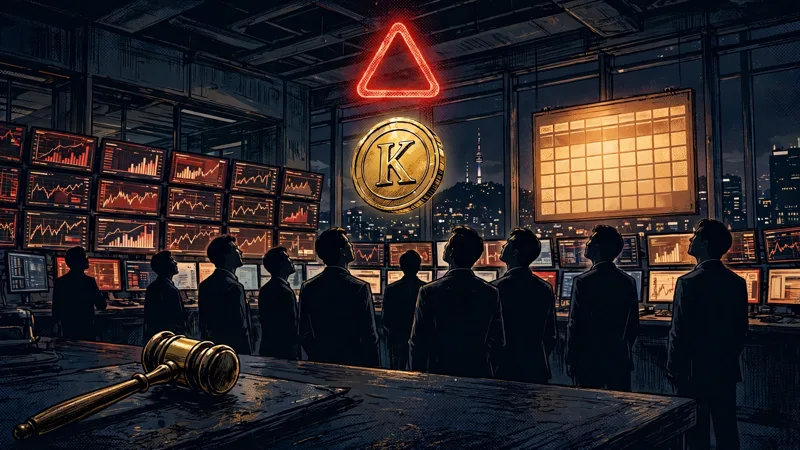
Upbit and Bithumb, South Korea's two largest cryptocurrency exchanges, designated Kava ($KAVA) a trading-caution asset on Monday, November 16, 2026, two days after the attack on its HARD Lend lending application that took about 53.9 million Kava. Both exchanges will decide between December 14 and 18 whether to lift the label, extend it, or end trading support for the token entirely.
The designation took effect at 14:00 Korea Standard Time, which is 05:00 UTC, and covers Upbit's KAVA/KRW and KAVA/BTC pairs, according to Blockchain Reporter's account of Upbit's notice. Bithumb applied the same label at the same time, calling Kava an investment-warning asset under its own trading-caution policy, according to Dave Finances. The label is a formal review status, not a delisting: trading continues on both exchanges, while deposits and withdrawals have been frozen since November 14.
Two exchanges, one label, one deadline
Upbit cited Article 17, item 1 of the enforcement decree of Korea's Act on the Protection of Virtual Asset Users. The clause covers a hacking or other security incident, whose cause has not been identified or remedied, occurring in a wallet controlled by the asset, its issuer or its operator, or in the distributed ledger where the asset is issued, transmitted or stored. Upbit said it had confirmed a possibility of causing damage to users, and designated Kava for investor protection.
Bithumb's notice used the same trigger. The exchange said its designation was based on confirmation of a security incident involving a cryptocurrency wallet or distributed-ledger infrastructure used to issue, transfer or store digital assets, where the cause remained unidentified or the incident had not been adequately remedied, according to Dave Finances. Bithumb separately cited Article 17(1)(e), which concerns deposit restrictions during procedures to terminate trading support, but that reference does not mean Bithumb has already decided to delist Kava.
Both exchanges named three possible outcomes for the December review: an extension of the warning, removal of the designation, or termination of trading support. Bithumb said its announced schedule could change for internal reasons, and that the warning can be removed before the review concludes if the underlying concerns are satisfactorily resolved. Neither exchange has disclosed what evidence it will require from Kava, or whether the project's newly announced security measures will satisfy its review committee.
What the designation actually orders
The practical effect falls hardest on moving tokens in and out. Upbit suspended Kava deposits and withdrawals at 19:36 KST on November 14, which is 10:36 UTC, and its November 16 notice says incoming transfers can no longer be credited, with all such deposits falling under a return process. When service resumes, only withdrawals will reopen, and Upbit has not published a date for that.
Bithumb's timeline is nearly identical. It scheduled its suspension of Kava deposits and withdrawals for 19:35 KST on November 14, and its November 16 notice confirmed the suspension remains in effect, with no date for restoring either service. Deposits received during the restriction will be processed according to the arrangements applicable when trading support is restored or terminated, according to Dave Finances.
Trading itself is untouched for now, which is the practical difference between a caution designation and a suspension. Holders can sell into the won or Bitcoin ($BTC) books while the review runs. What they cannot do is move coins in, so the Korean order books now trade against themselves, with no inbound supply to arbitrage against prices elsewhere. Coinone, the third major Korean exchange, also suspended Kava transfers on November 14, as MABOnChain reported at the time.
The four-rung ladder to delisting
Upbit publishes the sequence it is climbing. Its digital-asset trading-support termination policy describes a joint-response sequence used by members of DAXA, the council of Korean exchanges: a crisis occurs, a caution warning is issued, the asset is designated a trading-caution item, and trading support is terminated if the problem persists.
Kava entered at rung two on November 14, when Upbit issued a caution warning at 20:00 KST, twenty-four minutes after the transfer suspension, in a notice that said circumstances suggested a security problem on the Kava chain. It reached rung three on November 16 with the trading-caution designation. Rung four is not automatic: the policy says the committee weighs severity, the likelihood of resolution and the need to protect users across five review areas, covering issuer reliability, user protection safeguards, technology and security, legal compliance, and content-based assets.
Termination has its own published arithmetic. Upbit's policy grants a 30-day orderly trading period from the date of the termination notice, then supports withdrawals for 30 days from the termination date. A termination decided at the far edge of the December 14 to 18 window would therefore leave roughly 60 days of exit runway, landing in the second half of February 2027. The review window itself gives Kava 28 to 32 days to answer the exchanges.
The exploit behind the warning
The designation traces back to the November 14 attack on HARD Lend, the decentralized lending application previously known as Kava Lend. Kava confirmed on November 16 that about 53.9 million Kava was taken from the application, worth about $1.83 million at current prices and about $3.67 million at the pre-attack reference price of about $0.068, according to Kava's incident update and reporting by Dave Finances.
The attacker inflated a dormant Binance USD ($BUSD) collateral market about 243,000-fold through a rounding flaw, then borrowed 55.2 million Kava in 127 loans, according to on-chain analysis reported earlier by MABOnChain. The 55.2 million figure is the gross borrowing activity identified in transaction records; Kava's confirmed 53.9 million is the amount removed from the lending application. About 49.2 million Kava was bridged to BNB Chain ($BNB) through LayerZero, and 48.4 million was sold for about $2.09 million, according to the same reporting.
Kava said the flaw is blocked, protective measures are operating, and some attacker-controlled funds have been frozen, but it did not quantify the frozen amount or say how much of the stolen cryptocurrency has been recovered. The project said a governance proposal will be submitted to permanently disable new lending and borrowing through a seven-day vote, accelerating the retirement of HARD Lend. It has not published a lender-compensation plan or a full reconciliation of outstanding lender claims, and its incident update said individual user deposits were largely unaffected without giving the detail behind that statement.
Kava traded at $0.03425 at 06:44 UTC on November 16, down 5.6 percent over 24 hours and 49.8 percent over seven days, according to CoinGecko data cited by Blockchain Reporter. Its market capitalization stood at $37.09 million against $21.39 million of 24-hour volume, which means turnover equal to 57.7 percent of the entire market value changed hands in a day.
MANTRA set the precedent three days earlier
The exchanges ran the same procedure three days earlier. On November 13, Upbit and Bithumb announced they would terminate trading support for MANTRA ($OM) on December 14, after concluding that follow-up measures, including compensation arrangements after an earlier blockchain security incident, did not satisfy their continued listing standards, as MABOnChain reported at the time. The MANTRA case shows that fixing a technical vulnerability does not automatically resolve every issue an exchange weighs in a trading-support review.
Upbit ran the designation step on Initia ($INIT) on October 26, hours after Bithumb did the same, following a $2.7 million exploit whose cause had not been established. That review runs to the fourth week of November, the same four-week clock Kava now faces. The date that matters for Kava holders is therefore not today, but the week of December 14, when Upbit and Bithumb must each say whether the label comes off, stays on, or becomes a delisting.
This article is news reporting and is not investment advice.
Sources
- Upbit, Notice 6780, designation of Kava (KAVA) as a trading caution item, November 16, 2026, 14:00 KST (primary source: the designation covers KAVA/KRW and KAVA/BTC, the review runs to December 14 to 18, 2026, the cited legal basis is Article 17, item 1 of the enforcement decree of the Act on the Protection of Virtual Asset Users, incoming deposits cannot be credited and fall under a return process, and when service resumes only withdrawals will reopen), quoted in Blockchain Reporter's report below
- Blockchain Reporter, Upbit Flags KAVA: Deposits Shut, Review To Dec. 18, November 16, 2026 (secondary source: the 14:00 KST designation, the December 14 to 18 review window, the Article 17 citation, the deposit return process, the withdrawals-only resumption, the November 14 caution warning in notice 6777, the four-rung DAXA sequence, the 30-day orderly trading period and 30-day withdrawal support after any termination, and the CoinGecko price of $0.03425 at 06:44 UTC, down 5.6 percent in 24 hours and 49.8 percent over seven days)
- Dave Finances, Bithumb puts KAVA under warning, raising delisting risk, November 16, 2026 (secondary source: Bithumb's investment-warning designation at 14:00 KST, the December 14 to 18 decision window, the three possible outcomes, the early-removal possibility, the 19:35 KST November 14 suspension, the Article 17(2)(b) and Article 17(1)(e) citations, the 53.9 million KAVA taken, the 49.2 million bridged to BNB Chain, and the absence of a lender-compensation plan)
- Lookonchain, Upbit and Bithumb designate KAVA as a trading alert project, November 16, 2026 (secondary source: both exchanges designated Kava a trading alert project effective 14:00 KST on November 16, with a further announcement due in the third week of December, December 14 to 18)
- Kava Chain, HARD Lend Security Incident, November 16, 2026 (primary source for the exploit: about 53.9 million KAVA taken from HARD Lend on November 14, the identified exploit blocked, a portion of funds frozen, and a governance proposal to be submitted to permanently disable new lending and borrowing through a seven-day vote)
- Crypto Briefing, Kava accelerates HARD Lend wind-down after 53.9 million KAVA exploit, November 16, 2026 (secondary source: the seven-day governance vote plan, the wind-down acceleration, and the ongoing recovery with no statement that drained funds will be returned in full)
MABOnChain Daily Brief
The key crypto and markets stories in one short, plain-language email. Free. Unsubscribe any time.
Prefer chat? Join us on Telegram Watch on YouTube
Keep reading
Lighter Blames Leaked API Key for Drain and Aims to Reopen Withdrawals Before Monday Ends
Lighter said on November 16, 2026, that a leaked API key tied to one trader's account caused the drain that on-chain analysts put at about $15.5 million, and that its protocol and smart contracts were not affected. The exchange named the wallet it believes belongs to the attacker, switched on Guardian mode on its smart contract, and said its Security Council will carry out a contract upgrade so withdrawals can reopen before Monday ends. Lighter has not confirmed the $15.5 million total, and the suspected link to Abraxas Capital remains unconfirmed.

Strategy Buys 485 More Bitcoin as Its Treasury Sinks $9.6 Billion Underwater
Strategy bought 485 Bitcoin ($BTC) for $33.4 million in the week of November 9 to 15, 2026, according to a Form 8-K filed with the U.S. Securities and Exchange Commission on November 16, lifting its holdings to 850,849 coins. With Bitcoin trading at $64,154, the treasury is worth about $54.59 billion against a $64.20 billion cost, an unrealized loss of about $9.61 billion. Strategy spent far more buying back its own preferred stock, repurchasing $228.1 million of STRC, about 6.8 times what it spent on Bitcoin.
Lighter Attacker Moves $15.5 Million Into Monero as Full Loss Emerges
The total taken in the November 16 attack on decentralized perpetuals exchange Lighter is now put at about $15.48 million in USD Coin ($USDC) across two market-maker accounts, up from the $10.39 million first reported, and the attacker has already bridged 640 Ether ($ETH) to Hyperliquid to buy 2,240 Monero ($XMR), according to PeckShield. Leaked API keys let the attacker close the victims' positions and funnel the funds through a zero-fee public pool it controlled with about $10,000. Lighter has kept withdrawals suspended with no timeline for reopening.

Kava Confirms 53.9 Million KAVA Stolen in HARD Lend Exploit and Moves to Shut Lending Down for Good
Kava Chain confirmed on November 16, 2026, that about 53.9 million Kava ($KAVA) was taken from its HARD Lend lending application in an attack on November 14, worth about $3.76 million before the attack, and said it will ask token holders to vote on permanently disabling new lending and borrowing. The attacker inflated a dormant Binance USD ($BUSD) market about 243,000-fold, borrowed 55.2 million Kava in 127 loans, bridged 49.2 million to BNB Chain ($BNB) and sold 48.4 million for about $2.09 million. Kava says the flaw is blocked, some funds are frozen, and lenders still have no compensation plan.