

S&P Keeps Tether's USDT at Its Weakest Score as Riskier Reserves Climb to 28%
Published November 19, 2026, 05:15 AM PKT. Based on Cointelegraph's reporting of the S&P Global Ratings assessment (primary source), with TokenPost, Coin-Turk and Crypto Briefing as secondary sources.
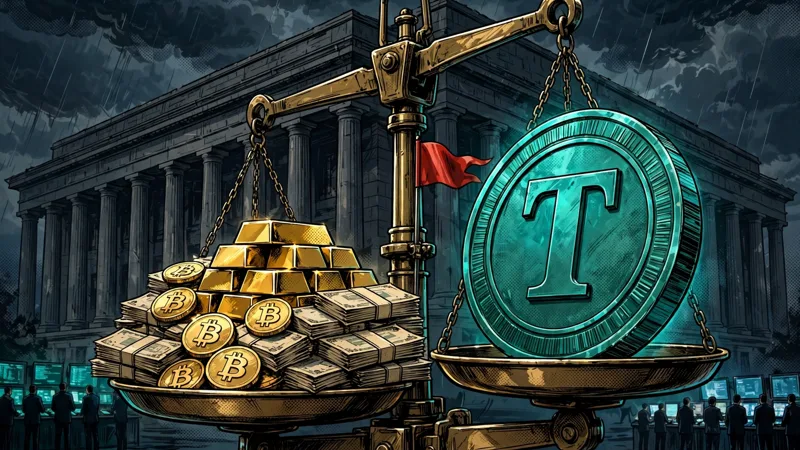
S&P Global Ratings kept Tether's USDt ($USDT) at 5, the weakest score on its stablecoin stability scale, in a report published on November 18, 2026, as riskier assets took up a growing share of the reserves behind the world's largest stablecoin. Higher-risk holdings, including gold, Bitcoin ($BTC), public equities, secured loans and corporate bonds, were equivalent to 28 percent of the tokens in circulation as of September 30, up from 24 percent a year earlier, according to Cointelegraph's account of the report. Tether pushed back within hours, telling Cointelegraph that the problem is S&P's framework, not its reserves, and invoking the film The Big Short, about the 2008 financial crisis, to make the point. The score itself did not change: it is the same 5 (weak) that S&P assigned in November 2025, and the agency said it found further weaknesses but made no downward adjustment because its assessment cannot go below 5.
The 28 percent figure, up from 24 percent
The core of S&P's concern is reserve quality. The agency counts gold, Bitcoin ($BTC), publicly traded equities, secured loans and corporate bonds as higher-risk holdings, and those assets equaled 28 percent of the tokens in circulation on September 30, 2026, against 24 percent a year earlier, according to TokenPost. S&P warned in the report that a significant drop in the value of those assets could leave USDT undercollateralized, according to Cointelegraph. Tether's own numbers tell a different story about the cushion. Its September 30 reserve report, attested by the accounting network BDO, showed approximately $191.5 billion in assets against $183.5 billion in liabilities, leaving roughly $7.95 billion in excess assets, according to Cointelegraph. The gap between the two readings is the argument: S&P looks at what the reserves are made of, Tether points to how much of them there are. S&P's scale runs from 1 to 5, and it rates Circle's USD Coin ($USDC) at 2, labeled strong, which shows how far apart the two biggest dollar stablecoins sit in the agency's framework.
Tether fires back with The Big Short
Tether did not accept the verdict quietly. "The problem is S&P's framework, not our reserves," Tether told Cointelegraph, adding, "Their own history shows the underlying problem," in a reference to The Big Short, the film about the 2008 financial crisis. The swipe is a familiar one for Tether. When S&P first cut USDT to 5 in November 2025, chief executive Paolo Ardoino wrote on X, "we wear your loathing with pride," and pointed to past financial collapses as proof that traditional systems are broken, according to Cointelegraph. Tether's position is that the framework ignores USDT's record of holding its peg through banking collapses, exchange failures and extreme market moves, and that most of its reserves sit in short-term US Treasuries and cash equivalents. S&P's concern sits with the minority slice of the reserves, and that slice is getting bigger, up four percentage points in a year.
El Salvador oversight and the audit gap
S&P's report went beyond reserve composition. The agency questioned the regulatory oversight of El Salvador, where Tether relocated in January 2025. The country's National Commission of Digital Assets, known as CNAD, requires 70 percent of the reserves to be held in assets that can be liquidated within 30 days, and Tether described that framework as broad because it allows holdings such as gold, Bitcoin ($BTC) and loans, according to Cointelegraph. S&P also pointed to the lack of a requirement to segregate reserve assets, unlike the rules expected by regulators in the United States and Europe, and said there is no publicly available information showing how the reserves are insulated from broader corporate risks. Disclosure was the other gap. In August 2026, KPMG confirmed it had issued an unqualified opinion on Tether's 2025 accounts, in the company's first full independent audit, but S&P said the audited statements and the auditor's report have not been published, which limits its ability to check the underlying information. Tether's reserve reports also do not name the custodians and counterparties holding its assets, and its attestations remain quarterly while other stablecoins generally report monthly, according to Cointelegraph.
A downgrade that dates to November 2025
The November 18 report is a reaffirmation, not a fresh downgrade, and the history matters. S&P launched its stablecoin stability framework in December 2023 and first rated USDT at 4, labeled constrained. On November 26, 2025, it cut the score to 5 (weak), citing persistent gaps in disclosure and a growing allocation of higher-risk assets, according to Crypto Briefing. The 2025 report counted those assets at 24 percent of circulation as of September 30, 2025, with Bitcoin ($BTC) at about 5.6 percent of circulation. The new report moves the higher-risk share to 28 percent and keeps the score where it is, because there is nowhere lower for it to go. S&P ended the November 18 report on a note Tether will quote back: the agency said Tether had maintained a good history of price stability, particularly in the last 12 months, according to Cointelegraph. USDT has kept trading near $1 through the whole dispute, including after the 2025 downgrade.
Bitcoin near $63,000 as the market absorbs the report
The report landed in a market already deep in fear. Bitcoin ($BTC) traded near $63,000 at the time of writing, and Ether ($ETH) traded near $1,760, with the Crypto Fear and Greed Index at 11, deep in extreme fear, according to MABOnChain's coverage on November 18. The same day brought a second headwind for crypto: minutes from the Federal Reserve's October 27-28 meeting, released on November 18, showed almost all officials judged further interest rate increases would likely be appropriate, MABOnChain reported, and the committee held rates at 3.75 to 4 percent in a 10-2 vote. A ratings agency keeping the world's largest stablecoin at its weakest score does not change the peg, and USDT has held $1 through every round of this argument so far. What it does change is the pressure on Tether to publish the KPMG audit, name its custodians and move to monthly attestations, because each of those is a fix S&P named in the report, and each would be visible to the market the day Tether makes it.
This article is news reporting and is not investment advice.
Sources
- Cointelegraph (via TradingView), Tether invokes The Big Short in swipe at S&P over USDT reserve risks, November 18, 2026 (primary source: S&P keeping USDt at 5 (weak) in its November 18 report, unchanged from November 2025; higher-risk holdings at 28 percent of circulation as of September 30, up from 24 percent a year earlier; S&P's warning that a significant drop in those assets could leave USDT undercollateralized; Tether's statement that the problem is S&P's framework, not its reserves, and its reference to The Big Short; the September 30 BDO-attested report showing about $191.5 billion in assets against $183.5 billion in liabilities and roughly $7.95 billion in excess assets; further weaknesses found but no downward adjustment because the assessment cannot be lower than 5; the El Salvador CNAD 70 percent rule and the lack of a segregation requirement; the KPMG unqualified opinion on Tether's 2025 accounts in August 2026, with the audited statements unpublished; custodians and counterparties unnamed and quarterly attestations against monthly reporting by peers; Ardoino's "we wear your loathing with pride" response to the 2025 downgrade; S&P noting Tether's good history of price stability, particularly in the last 12 months)
- TokenPost, Tether Blames S&P Framework as USDt (USDT) Assessment Stays at 5, November 18, 2026 (secondary source: the score of 5 as the bottom of S&P's stablecoin stability scale, matching the November 2025 assessment; higher-risk holdings at 28 percent of circulation on September 30 against 24 percent a year earlier; gold, Bitcoin (BTC), publicly traded equities, secured loans and corporate bonds classified as higher risk; the September 30 reserve report figures; the KPMG audit and unpublished statements; the El Salvador CNAD 70 percent rule)
- Coin-Turk, S&P confirms Tether's USDT stability rating at lowest level as reserve risk grows, November 18, 2026 (secondary source: S&P reaffirming USDT's stability score at 5 on November 18, consistent with the November 2025 assessment; higher-risk assets at 28 percent of circulation as of September 30, up from 24 percent; the $191.5 billion in assets against $183.5 billion in liabilities and about $7.95 billion in excess assets; the KPMG unqualified opinion in August 2026)
- Crypto Briefing, S&P Global Ratings downgrades Tether's USDT peg assessment to weak, November 18, 2026 (secondary source: the November 26, 2025 cut from 4 (constrained) to 5 (weak); the previous score of 4 dating to December 2023; higher-risk holdings at 24 percent of reserves as of September 30, 2025; Bitcoin at about 5.6 percent of circulation in 2025; the overcollateralization buffer at around 3.9 percent in 2025)
- OKX, S&P Global Assigns First-Ever B- Credit Rating to DeFi Platform Sky Protocol, November 18, 2026 (secondary source: S&P's stablecoin assessment ranking Circle's USDC at 2 (strong), Tether's USDT at 4 (constrained) before the 2025 cut, and the framework launching in December 2023)
- MABOnChain, Fed Minutes: More Hikes Likely, With a 50 Basis Point December Move on the Table, November 18, 2026 (own coverage: the Federal Reserve minutes showing almost all officials judged further rate increases likely appropriate; the 10-2 vote holding rates at 3.75 to 4 percent; the Crypto Fear and Greed Index at 11)
MABOnChain Daily Brief
The key crypto and markets stories in one short, plain-language email. Free. Unsubscribe any time.
Prefer chat? Join us on Telegram Watch on YouTube
Keep reading

Anthropic Prices IPO at $83, Valuing Claude Maker at $1.5 Trillion as Tokenized Shares Sell Out
Anthropic priced its initial public offering at $83 a share on November 18, 2026, above its $70 to $78 range, according to Reuters, Bloomberg and CNBC. The 825 million share offering would raise about $68.5 billion, with a separate $26 billion private placement taking the combined total above $94 billion. Tokenized Anthropic shares sold out in hours on Binance Wallet, and crypto traders had already priced the stock near $99 on Hyperliquid.

Binance Secures Abu Dhabi Court Order to Recover Frozen Funds From $6.3 Billion Hack
Binance said on November 18, 2026, that it secured a court order from the Abu Dhabi Global Market courts to help recover cryptocurrency frozen after the October 29 theft of about $6.3 billion. About $2.85 billion of the stolen tokens have been frozen or intercepted by third parties, and the U.S. Department of Justice has court authority covering more than $1.2 billion. Bitcoin ($BTC) traded near $62,700.
Fed Minutes: More Hikes Likely, With a 50 Basis Point December Move on the Table
The Federal Reserve released the minutes of its October 27-28, 2026 meeting on November 18, showing almost all officials judged further interest rate increases would likely be appropriate and a couple said a bigger-than-25-basis-point move could warrant consideration at the December 8-9 meeting if inflation data came in unfavourable. The committee held rates at 3.75 to 4 percent in a 10-2 vote, with Lisa Cook and Beth Hammack dissenting for a hike. Bitcoin ($BTC) traded near $64,600.

Polygon Eyes U.S. Banking Licence, Plans $50M to $100M per Acquisition
Polygon co-founder Sandeep Nailwal told Moneycontrol in an interview published November 18, 2026, that Polygon is considering applying for a U.S. banking licence and plans to spend $50 million to $100 million on each acquisition as it builds a globally licensed payments network over the next one to two years. The targets span North America, the European Union, Brazil, Mexico and Southeast Asia, with the long-term goal of becoming a global correspondent bank. Polygon has already made an offer for a European company and identified another target in North America. Polygon ($POL) traded near $0.081.