

SEC Grants 5-Year 'Innovation Exemption' for On-Chain Trading of Tokenized U.S. Stocks
Published October 12, 2026, 03:00 PKT. Based on the SEC press release, Release No. 2026-90, and order File No. 4-927 (September 17, 2026), October 8 analysis by McDermott Will & Emery and Mondaq, October 9 reporting by Memeburn, and October 11 reporting by Basis Desk.
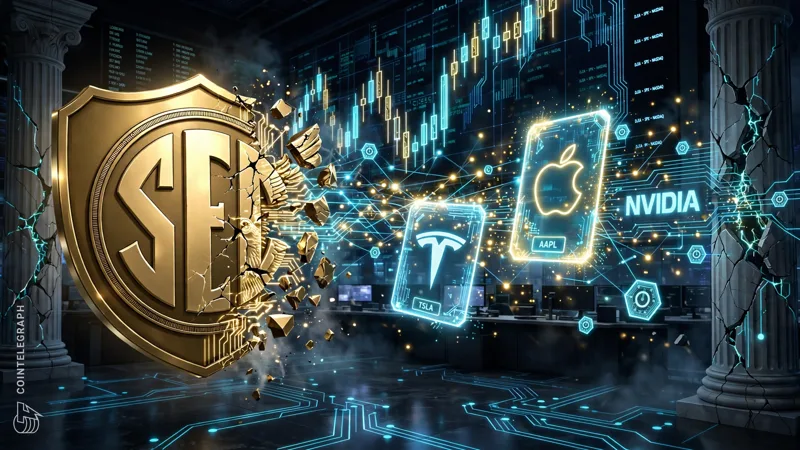
The U.S. Securities and Exchange Commission has issued a temporary five-year exemption that lets a new kind of venue trade tokenized versions of U.S.-listed stocks on public blockchains without registering as a national securities exchange. The order, issued September 17, 2026 under Release No. 2026-90 and File No. 4-927, creates a conditional pilot framework the SEC calls the Innovation Exemption, according to the agency's press release.
The five-year pilot
The relief runs for five years and expires on September 17, 2031, according to the McDermott Will & Emery client alert published October 8. The SEC granted it under Section 36(a)(1) of the Securities Exchange Act of 1934, per an institutional analysis published October 7, and has opened a public comment period as it considers whether and how a permanent framework should follow. The Commission asks commenters to weigh in on adjustments to the conditions and the shape of permanent rules.
SEC Chairman Paul S. Atkins described the relief as a measure to advance domestic capital markets into the digital era while the Commission evaluates broader on-chain trading policies, Basis Desk reported. Jamie Selway, Director of the SEC Division of Trading and Markets, said staff would coordinate with entities seeking to operate under the new framework. Mondaq reported that Atkins linked the action directly to Congress's failure to advance the CLARITY Act, calling the order a statutory-authority step toward on-chain trading after delays to that legislation.
Two kinds of relief
The order grants two separate exemptions. First, qualifying Tokenized Securities Venues, or TSVs, receive relief from the Exchange Act's definition of an exchange, so they can facilitate secondary-market trading of tokenized National Market System stocks through permissioned automated market makers and liquidity pools, McDermott reported. Second, firms that commit proprietary capital to those liquidity pools receive conditional relief from the definition of dealer under Section 3(a)(5), even where their activity involves quoting prices or entering committed capital arrangements, Basis Desk reported.
Trading happens through permissioned automated market makers and liquidity pools on public, permissionless ledgers, with the participant set closed to approved counterparties. The relief covers tokenized versions of shares that already trade on the national exchanges, wrapped into blockchain tokens either by the issuer or by an unaffiliated third party, according to the October 7 institutional analysis. Only tokens backed by real NMS stocks with full voting, dividend and economic rights qualify; synthetic tokens, derivative swaps and unbacked rights are excluded.
What TSVs must do
The conditions are designed to protect investors and limit disruption to traditional markets. Venues must deploy smart contracts that are public and auditable, hosted on a public, permissionless distributed ledger, per Basis Desk. They must confirm tokenized assets convey identical rights to the underlying shares, set trading volume and symbol ceilings, and halt trading whenever the primary listing exchange halts the underlying equity, Mondaq reported.
The 30-day issuer objection window
If a third party tokenizes a company's shares without the issuer's involvement, the venue must notify the company in writing before trading begins and give it 30 days to object, Basis Desk reported. If the issuer formally objects, trading of that token does not go ahead, giving companies a safety valve against unwanted on-chain liquidity or governance complications, according to the October 7 institutional analysis.
That window is already in motion. On October 4, OKXICE, the joint venture between OKX and NYSE owner Intercontinental Exchange co-chaired by former New York Governor Andrew Cuomo, notified the SEC that it intends to operate a TSV under the Innovation Exemption, listing 63 U.S.-listed stocks including Nvidia, Tesla, Apple, Microsoft, Amazon, Alphabet, JPMorgan Chase, Goldman Sachs, Walmart, Netflix, Coca-Cola, Boeing, Cisco, IBM, Palantir, AMD, Coinbase, Robinhood, Circle, Reddit and Strategy, Memeburn reported. With the 30-day clock running, the earliest possible launch is early November. One wrinkle: chipmaker Cerebras already filed an objection even though it was not on the list.
The order arrives as the real-world-asset tokenization market reaches roughly $39 billion in distributed asset value, according to RWA.xyz data cited by RWA Signal on October 10. Securitize launched tokenized U.S. stock trading on October 8, and MABOnChain previously covered Securitize's Solana launch and OKXICE's filing.
This article is news reporting and is not investment advice.
Sources
- U.S. Securities and Exchange Commission, "SEC Issues Innovation Exemption to Facilitate the Trading of Tokenized NMS Stock and Request for Comment," Release No. 2026-90, order File No. 4-927 (September 17, 2026), primary source for the Innovation Exemption, the TSV and dealer relief, the conditions, Chairman Atkins and Director Selway's statements, and the comment request
- McDermott Will & Emery, "SEC tests new framework for on-chain trading of tokenized stocks" (October 8, 2026), secondary source for the September 17, 2031 expiration and the exemption mechanics
- Mondaq, "CFTC Launches Crypto Market Structure Rulemaking as SEC Advances Its Own Digital Asset Framework" (October 8, 2026), secondary source for the CLARITY Act linkage and the condition list
- Memeburn, "Tokenized Stocks 2026: How 63 U.S. Shares Will Trade 24/7" (October 9, 2026), secondary source for the OKXICE TSV notice, the 63-stock list, and the Cerebras objection
- Basis Desk, "SEC Issues Innovation Exemption for Tokenized Stocks" (October 11, 2026), secondary source for the framework summary and the 30-day issuer objection rule
- RWA Signal / RWA.xyz (October 10, 2026), secondary source for the $39 billion tokenization market figure and the Securitize launch
MABOnChain Daily Brief
The key crypto and markets stories in one short, plain-language email. Free. Unsubscribe any time.
Prefer chat? Join us on Telegram
Keep reading
Ledger Spy Implant Scare Reaches Europe as PeckShield Traces $3.89M in Theft Funds to Binance
A Ledger user in Europe reported finding a spy implant inside a device bought from an official reseller, extending the supply-chain attack beyond Southeast Asia. PeckShield traced $3.89 million of the stolen funds to Binance deposits on Tron, and Galaxy Research now puts total losses at $91 million across nearly 500 addresses.
Coldcard's X Account Hijacked to Push Fake Firmware Phishing Scam
Attackers took over the official X account of Bitcoin hardware wallet maker Coldcard on October 11 and published a phishing post claiming a critical firmware vulnerability, urging users to migrate funds through a fraudulent page. Coldcard deleted the post, warned users not to click, and said its internal security remains intact.
Russia Puts Crypto Miners on Lowest-Priority Power Under New Grid Rules
Russia's government adopted Resolution No. 1300 on October 6, requiring crypto mining farms, mining pools and mining infrastructure operators to accept Category 4 grid connections, the lowest reliability tier, meaning their electricity can be cut first during shortages.