

China's Central Bank Confirms It Halted Solana's Shanghai Event and Opens Investigation
Published November 7, 2026, 12:50 PM PKT. Based on the People's Bank of China's statement of November 6, 2026, given to Financial News, a newspaper run by the central bank (primary source), as reported by crypto.news and BeInCrypto (secondary reporting).
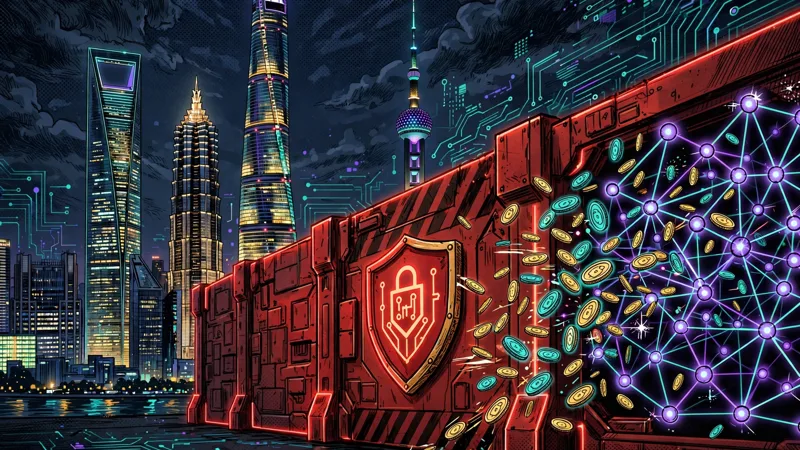
China's central bank has confirmed that authorities halted Solana's promotional event in Shanghai and will investigate the domestic companies and individuals behind the blockchain network's marketing campaign in the country. The People's Bank of China said Solana ($SOL) used a domestic company to run high-profile advertisements for its brand and coin, including a prominent display on the outside wall of Citigroup Tower in Shanghai's Lujiazui financial district. The central bank said the campaign amounted to cryptocurrency promotion, which is prohibited under China's existing regulations, and it coordinated with local financial regulators, police and market supervision authorities to stop the planned Solana Accelerate China 2026 event. No companies or individuals under investigation have been named and no penalties have been announced.
The Citigroup Tower ads that drew the central bank's attention
The intervention was triggered by visibility, not by a transaction. According to an exclusive report by China's Financial Times, a People's Bank of China official said monitoring showed Solana working with domestic entities to advertise its brand, including the display on Citigroup Tower, one of the most prominent buildings in Shanghai's financial district. The campaign also included executives publicizing a new Shanghai office and a four-city developer tour, with gatherings planned in Shanghai, Hangzhou, Shenzhen and Beijing between October 16 and 22, covering blockchain infrastructure, artificial intelligence, payments and other applications. The central bank said the advertising campaign amounted to cryptocurrency promotion, which is prohibited under China's existing regulations.
The Shanghai stop was scheduled for October 16 at the Shangri-La Hotel. That morning, attendees arriving at the venue found police officers outside and were kept waiting for more than an hour, BeInCrypto reported at the time. Organizers emailed registered guests that the gathering was postponed, citing logistical difficulties at the venue, and said participants would receive further information once a revised schedule was available. The People's Bank of China has now confirmed what the police presence suggested: authorities halted the event before it opened, and the official said events in Shanghai and other locations were stopped as well.
Why the central bank says promotion itself breaks the rules
The official gave two reasons for treating the campaign as a violation. First, Solana's native token, SOL, is a virtual currency under Chinese rules. Second, Solana's blockchain infrastructure supports the issuance and trading of other cryptocurrencies, including Tether's dollar-pegged USDT stablecoin. On that basis, the central bank considers the promotion of Solana's brand itself a violation of the February 2026 regulatory notice, crypto.news reported. The official added that cryptocurrencies currently cannot adequately satisfy customer identification and anti-money laundering requirements, while their trading can encourage market speculation.
The February 2026 notice was issued jointly by the People's Bank of China and seven other government agencies, and it replaced the corresponding 2021 notice while maintaining the prohibition on unauthorized virtual-currency financial activities. It reaffirmed that Bitcoin ($BTC), Ethereum ($ETH), stablecoins and other virtual currencies do not have the same legal status as China's sovereign currency, and it prohibited unauthorized cryptocurrency trading, token issuance and related financial services within mainland China. The notice also restricted domestic companies and individuals from assisting overseas cryptocurrency businesses that illegally provide services to mainland customers, and it placed specific restrictions on unauthorized yuan-pegged tokens and certain real-world asset tokenization activities.
The October 16 shutdown, and the capacity explanation
Solana Foundation President Lily Liu offered a different explanation for the postponement at the time. In an October 16 post on X, Liu said registrations had quadrupled overnight following publicity around the event, far exceeding the attendance cap the organizers had registered with local authorities, and that the gathering would be postponed to comply with local requirements. The central bank's statement, published November 6, is the first official account of the intervention, and it explicitly links the cancellation to regulatory action against Solana's promotional activities rather than to crowd size.
The episode also drew a public reaction from Binance co-founder Changpeng Zhao, who questioned whether Solana's organizers had adequately considered China's cryptocurrency regulations. Zhao wrote on X that it was sad to see, and asked whether the organizers really did not know the local policies, pointing to a similar disruption involving a Solana event in Shenzhen less than a year earlier. Days before the Shanghai event, Zhao had praised Solana's new Shanghai office as a step that BNB Chain ($BNB) had not managed, BeInCrypto reported.
A second brush with Chinese police in a year
It was not Solana's first brush with Chinese police. In October 2025, officers questioned its Accelerate APAC event in Shenzhen, and organizers cut a hackathon session, BeInCrypto reported. The Shanghai intervention is the more serious of the two, because it comes with a formal investigation and a statement of the legal theory behind it, rather than a quiet disruption on the day. The central bank said regulators would work with local governments and other departments to pursue cryptocurrency-related businesses operating within mainland China, and that enforcement will specifically target domestic cryptocurrency dealers and China-based entities affiliated with overseas cryptocurrency issuance and trading platforms.
The intervention follows another Chinese crackdown on cryptocurrency-related risks reported in late October, when authorities called for stronger action against the use of digital assets in corruption and illicit financial activity. China has maintained restrictions on cryptocurrency trading and related financial services since 2021, when trading and related services were identified as illegal financial activities, and the 2013 position that Bitcoin could not circulate as legal currency still stands. The November 6 announcement does not introduce a new nationwide ban on Solana, and Chinese residents already could not legally buy SOL at home before this statement, BeInCrypto reported.
What happens next
The investigation is the next thing to watch. The central bank has not named the domestic companies or individuals it is investigating, and it has not announced any penalties, so the first concrete development will be whether names or fines emerge. The second is whether the remaining stops on the four-city tour, in Hangzhou, Shenzhen and Beijing, are formally cancelled or quietly abandoned, since the official said events in Shanghai and other locations were halted. The third is whether other overseas crypto projects with mainland marketing operations pull back, since the February 2026 notice makes the domestic intermediary, not just the foreign project, liable.
Solana ($SOL) traded near $90.05 when BeInCrypto published its report on November 6, down about 7% over 24 hours, though the broader crypto market was also down and the decline cannot be attributed to the China statement alone. The case shows where Beijing draws its line: it is building its own national blockchain network while treating public tokens, and the people who market them inside China, as illegal finance. For any project planning a mainland presence, the lesson of the Shanghai shutdown is that a billboard in Lujiazui counts as a financial activity, and the central bank is watching the skyline.
Sources
- People's Bank of China, official statement, November 6, 2026 (primary source: authorities halted the Solana Accelerate China 2026 event in Shanghai and will investigate the domestic companies and individuals involved in promoting the blockchain network, SOL is a virtual currency, Solana infrastructure supports issuance and trading of tokens including Tether's USDT, promotion violates the February 2026 notice; statement given in an exclusive interview to Financial News, a newspaper run by the central bank, as reported by crypto.news, China central bank targets Solana over Shanghai advertising and canceled event, November 6, 2026)
- BeInCrypto, China Opens Solana Investigation After Police Stop Shanghai Event, November 6, 2026 (secondary reporting: PBOC spoke through Financial News, ads on Citigroup Tower in Lujiazui, event stopped before doors opened, February 2026 notice from eight agencies, no companies or people named, SOL near $90.05, down 7% in 24 hours, October 2025 Shenzhen disruption)
- MABOnChain reporting, November 2026 (context: China's cryptocurrency trading restrictions since 2021, the February 6, 2026 notice from eight government agencies, the October 16, 2026 Shanghai shutdown and Lily Liu's capacity explanation)
This article is news reporting and is not investment advice.
MABOnChain Daily Brief
The key crypto and markets stories in one short, plain-language email. Free. Unsubscribe any time.
Prefer chat? Join us on Telegram Watch on YouTube
Keep reading

Keplr Pauses Google and Apple Login After Unauthorized Transactions in Web3Auth Wallets
Keplr Wallet paused Google and Apple sign-in on November 7, 2026, after reports of unauthorized transactions affecting users who logged in through Web3Auth social login, and warned those users to stop sending funds to their accounts. Web3Auth has suspended its embedded wallet services while a forensic investigation runs. Keplr said in its initial assessment that accounts secured with a recovery phrase or a hardware wallet are unaffected. No amount lost and no user count have been disclosed yet, and no timeline has been given for restoring the login methods.

MEXC Says It Is Operating Normally After FinCEN Cutoff, Launches Independent Review
Crypto exchange MEXC said in a November 6, 2026, statement that it is reviewing the US Treasury's Financial Crimes Enforcement Network order that cuts MEXC Global off from the US financial system, that the platform is operating normally with user assets secure, and that it has launched an independent review of its anti-money-laundering and sanctions controls. The order, issued November 6 under Operation Economic Outcast, cites about $16.7 billion in illicit-linked flows from May 2021 to May 2026 and takes effect 30 days after publication in the Federal Register, which had still not happened on the morning of November 7. A7, the Russian payment network named in the order, denied helping Iran or terrorist groups.

CFTC Tells Prediction Markets to Drop State Geoblocks Within 30 Days
The US Commodity Futures Trading Commission told federally registered prediction markets on November 5, 2026, to end state-by-state geographic access restrictions within 30 days or explain to its Division of Market Oversight why they cannot comply. The interpretation of the agency's impartial access rule, Commission Regulation 38.151(b), sets a deadline of about December 5 and lands as exchanges such as Kalshi and Polymarket face court-ordered geoblocks in Michigan, Nevada, Washington, Massachusetts and on California tribal lands. The CFTC named no exchange or state, and the guidance does not resolve what happens when a federal order meets a court injunction.

Akedo (AKE) Rebounds About 150% From November Low as Points Redemption Returns
Akedo (AKE) has rebounded about 150% from its November 5 low near $0.00189 to about $0.0048 on November 7, 2026, after AKEDO restored points redemption following a system upgrade and expanded its AI creation platform with conversation history, AI chat, game-making and image-generation tools. CoinGecko markets data captured at 04:52 UTC put AKE at $0.0047735, up 9.00% in 24 hours, with a $108.5 million market value and $155.2 million of 24-hour trading volume. The token is still down 57.16% over 7 days and 81.40% over 30 days, and 96.75% below its September 20 all-time high of $0.146656, while the next scheduled unlock of about 2.1 billion AKE falls around November 21.