

EU Launches Crypto Task Force to Block Russian Sanctions Evasion
Published November 8, 2026, 12:45 PM PKT. Based on the European Commission statement of November 7, 2026 (primary source), and reporting from Bitcoin.com, EU Perspectives and CoinCentral. Background on the FinCEN action against MEXC from MABOnChain reporting of November 6 and 7, 2026.
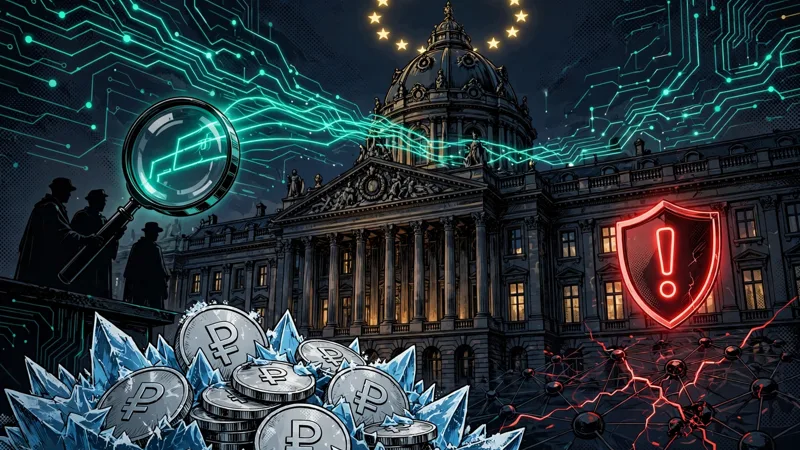
The European Union has created a dedicated crypto task force to stop Russia from using digital assets to evade its sanctions, the European Commission announced in a statement published on November 7, 2026. The unit will sit inside a new sanctions office and focus on detecting and disrupting crypto networks that help Moscow move money outside the traditional financial system, with the A7A5 ($A7A5) digital ruble stablecoin, which handled more than $100 billion in transactions, named as the kind of network it is built to target.
Commissioner Maria Luís Albuquerque, who oversees financial services and sanctions implementation, announced the launch after chairing the tenth meeting of the High-Level Expert Group on Union Restrictive Measures, a gathering of senior sanctions officials from every member state, the Commission and the European External Action Service. "I am pleased to announce the launch of the EU Crypto Sanctions Task Force," Albuquerque said in the statement. "This is an important step in strengthening our capacity to detect and tackle attempts to circumvent EU financial sanctions through crypto assets."
The task force sits inside a new sanctions office
The task force is one of two new tools announced at the meeting. The other is a dedicated sanctions office inside the Commission that will coordinate member states across the whole life cycle of sanctions, from policy design and implementation to enforcement support and anti-circumvention work, the Commission said. The office is meant to close the gaps that let sanctioned money keep moving even after the EU adopts new restrictions.
According to the Kyiv Independent, the task force is expected to run for 12 months, with support from Ukraine and the United Kingdom, Bitcoin.com reported. Both countries have already targeted Russian crypto networks on their own, and their experience is expected to feed into the task force's work.
The meeting also examined the role of the European Anti-Fraud Office, known as OLAF, in investigating sanctions circumvention, and member states' efforts to enforce the measures consistently. "We cannot allow loopholes, uneven enforcement or circumvention to undermine our collective efforts," Albuquerque said. "We will not allow new technologies or third-country jurisdictions to become safe havens for sanctions evasion."
EU spokesperson Siobhan McGarry told journalists on November 6 that the problem is already established fact inside the Commission. "We know that crypto is a tool that has been used to circumvent our sanctions," McGarry said, EU Perspectives reported.
A7A5, the $100 billion ruble stablecoin
The clearest example of the problem the task force is meant to solve is A7A5, a digital ruble stablecoin created by the Russian firm A7 to help businesses make cross-border payments despite sanctions, EU Perspectives reported. Blockchain analytics firm Elliptic tracked more than $102 billion in transactions through A7A5 before coordinated US, UK and EU sanctions hit it, and by June 2026 its daily volumes had fallen 96 percent from their peak a year earlier, the outlet reported.
The A7 network is not the only target the EU has named. In March 2025, US and European authorities took down Garantex, a Moscow-based crypto exchange used to move money around Western restrictions, EU Perspectives reported. The takedown showed that enforcement can reach the infrastructure itself, not just the wallets that use it.
What the task force adds is a standing team whose only job is the crypto side of evasion. Until now, that work was spread across national authorities and general sanctions teams. The new unit brings together experts from across the Commission and the member states, EU Perspectives reported, with a mandate to trace wallets, map networks and feed findings back to the authorities that can act on them.
The EU has been tightening the crypto net since July
The task force is the latest step in a campaign the EU has run since the summer. In July 2026, its 20th sanctions package targeted the complete Russian crypto ecosystem, Bitcoin.com reported. The 21st package, adopted on July 23, banned EU operators from dealing with 14 crypto platforms based in Georgia, Panama, the United Arab Emirates, the Marshall Islands, Kyrgyzstan and Belarus, and it introduced the option of banning entire crypto jurisdictions, ordering European exchanges to stop transactions with services established in named countries, EU Perspectives reported.
The Commission is now working on a 22nd package, EU Perspectives reported. The task force's findings are expected to shape what that package covers, and whether the jurisdiction-ban power gets used against new crypto hubs.
Washington is moving on the same front
The EU move comes days after the US Treasury's Financial Crimes Enforcement Network cut MEXC off from the US financial system on November 6, alleging the exchange processed about $16.7 billion in transfers linked to illicit activity between May 2021 and May 2026, including about $1.5 billion in Russian sanctions evasion, as MABOnChain reported. The two actions target different ends of the same problem: the US order hits a single exchange, while the EU task force is built to map the networks that keep forming around each crackdown.
The timing also matters for exchanges operating in Europe. The 21st package's jurisdiction bans already force European platforms to cut off services based in named countries, and the task force's work is likely to produce new names for that list. For compliance teams, the message from Brussels is that crypto sanctions evasion is now a standing enforcement priority, not a one-off package item.
What to watch next
Three things will show whether the task force has teeth. The first is whether it names specific platforms or wallet networks in its first months, and whether member states act on its findings with designations or enforcement cases. The second is the shape of the 22nd sanctions package, and whether it uses the 21st package's jurisdiction-ban power against new crypto hubs. The third is whether the task force survives past its 12-month term, or becomes a permanent part of the sanctions office, a decision that will signal how seriously Brussels treats crypto evasion as a long-term threat.
Sources
- European Commission, Statement by Commissioner Albuquerque on the outcomes of the tenth meeting of the High-Level Meeting on sanctions implementation, November 7, 2026 (primary source: Albuquerque announced the launch of the EU Crypto Sanctions Task Force after chairing the tenth meeting of the High-Level Expert Group on Union Restrictive Measures; the task force will strengthen capacity to detect and tackle attempts to circumvent EU financial sanctions through crypto assets; the meeting also covered crypto assets as an emerging threat, the role of OLAF in investigating sanctions circumvention, and member states' efforts to ensure consistent enforcement)
- Bitcoin.com, EU Deploys Dedicated Crypto Task Force to Block Russian Evasion, November 7, 2026 (secondary reporting: the task force sits inside a new sanctions office covering policy design, implementation, enforcement support and anti-circumvention; according to the Kyiv Independent, the task force is expected to work for 12 months with support from Ukraine and the UK; A7A5 registered transaction volumes of over $100 billion; the 20th sanctions package targeted the complete Russian crypto ecosystem in July; the 21st package introduced the possibility of banning entire crypto jurisdictions)
- EU Perspectives, Russian token moved $102bn. Brussels answers with sanctions office, November 6, 2026 (secondary reporting: A7A5 moved more than $102 billion according to Elliptic, with daily volumes down 96 percent from peak by June 2026; the task force brings together experts from across the Commission and member states; spokesperson Siobhan McGarry said on November 6 that crypto has been used to circumvent sanctions; the 21st package, adopted July 23, banned EU operators from dealing with 14 crypto platforms in Georgia, Panama, the United Arab Emirates, the Marshall Islands, Kyrgyzstan and Belarus; the Commission is working on a 22nd package; Garantex was taken down by US and European authorities in March 2025)
- CoinCentral, How the EU's New 12-Month Crypto Task Force Plans to Trace Russia-Linked Wallets, November 8, 2026 (secondary reporting: the task force is initially set to run for 12 months, drawing on experts from Ukraine and the UK)
- MABOnChain, US Treasury Cuts MEXC Off From US Financial System Over $16 Billion in Alleged Illicit Flows, November 6, 2026 (MABOnChain reporting: FinCEN cut MEXC off from the US financial system on November 6, alleging about $16.7 billion in transfers linked to illicit activity between May 2021 and May 2026, including about $1.5 billion in Russian sanctions evasion)
This article is news reporting and is not investment advice.
MABOnChain Daily Brief
The key crypto and markets stories in one short, plain-language email. Free. Unsubscribe any time.
Prefer chat? Join us on Telegram Watch on YouTube
Keep reading
OKX Founder Warns MEXC Users to Avoid Direct Transfers After USDT Deposits Get Frozen
OKX founder Star Xu told users on November 7, 2026 to stop sending funds directly from MEXC to OKX after customers reported Tether ($USDT) deposits frozen for compliance review, as Binance and Gate users reported similar checks and a first token issuer asked to leave MEXC. The warning follows FinCEN's November 6 order cutting MEXC off from the US financial system over about $16.7 billion in transfers linked to illicit activity.

Meteora ($MET) Jumps 15% as Trading Volume Surges After $1WIN Debut on Solana
Meteora ($MET) climbed about 15% in 24 hours to $0.32 on November 8, 2026, as 24-hour trading volume surged past $54 million and the Solana liquidity protocol outperformed a flat crypto market. CoinMarketCap analysis flagged a 181% volume spike behind the first leg of the move, and the rally extended after the $1WIN token debuted on Meteora following a $61 million public sale that was oversubscribed more than 15 times. Meteora ($MET) is still down about 27% over the past 30 days.

Keplr Says Web3Auth Flaw Exposed Private Keys, Tells Social-Login Users to Move Funds
Keplr has told users who created wallets with Google or Apple logins to stop sending funds to those accounts and move remaining assets to wallets made with a recovery phrase or a hardware wallet, after confirming that a flaw in Web3Auth's infrastructure exposed some private keys. Keplr co-founder Josh Lee estimated about 20 percent of social-login accounts could be affected, though only a fraction appeared exploited. Neither company has disclosed an official loss total.

South Korea Summons Every Crypto Exchange Security Chief for November 19 Hack Response Meeting
South Korea's Financial Supervisory Service will summon the chief information security officers of every registered crypto business in the country for a hacking-incident response meeting on November 19, 2026, after a string of data leaks and asset thefts at domestic exchanges. Gopax halted all deposits, withdrawals and trading on November 6 after a hacking threat email, Bithumb disclosed a breach of its internal groupware that exposed personal data of 715 employees and 844 customers, and the smaller exchange Prabang lost about 100 million won, roughly $73,000, in unauthorized withdrawals from a hot wallet.